Showing posts with label Alexandria. Show all posts

Thursday, November 1, 2012


An AHC Inc.-developed affordable housing complex at the corner of East Reed Avenue and Route 1/Jefferson Davis Highway, in Alexandria, is now slated for an early 2014 groundbreaking, after hitting delays earlier this year.

The latest iteration of the project, which has increased to 77 units, from an original 59, should head to the Alexandria City Council in December for final approval, according to John Welsh, Vice President at AHC.

"We're really happy with the design," says Welsh.  "The city planning office gave their opinion on it, and asked for a few minor changes.  Mostly design stuff - switching a metal accent to the other side of the building so it would be a stronger element on Route 1, that kind of thing."


The Bonstra-Haresign-designed building will offer 15 one-bedroom units, 51 two-bedroom units, and eleven three-bedroom units, at 60% of AMI (approximately $56,000/year).  The facade is "primarily brick, with a few other materials, and some metal accents to give it a nice polish," said Welsh.  The building will be five stories tall on the east side, and taper down to three stories on the west, and there will also be 77 below-grade parking spaces, a one-to-one ratio that marks a significant increase from the earlier design's 0.77 ratio, a number that caused some consternation among city planners as potentially insufficient.  Construction is projected to take 18 months, with leasing estimated to take until the end of 2015.

The project will sit on a joined plot consisting of a city-owned parcel at 3600 Jefferson Davis Highway and three privately-owned parcels controlled by AHC.  Funding is being provided by a package of AHC funds, a $1.1 million-plus affordable housing loan from the city, and tax credits, the application deadline for the latter contributing, at least in part, to past delays.

Wednesday, April 25, 2012


A proposed 59-unit affordable housing project in Alexandria, at the corner of East Reed Avenue and Route 1/Jefferson Davis Highway, has been delayed a year after developers at AHC, Inc. missed a mid-March deadline for their affordable housing tax credit application.  Developers are now aiming for a March 2013 application.

Though the project has been in the works for almost two years, a number of issues prevented the application from coming together in time. While city planners supported the project, calling it "an excellent opportunity to secure affordable housing, with minimal City financial support, in an area that will soon redevelop in a way that would likely make such a project unfeasible in the future due to escalating land values," they also raised concerns over the streetscaping. Planners also cited the possibly inadequate amount of parking contained in the proposed design (0.7 spaces per unit rather than their preferred ratio of 1.1 spaces per unit), and redesigns couldn't be produced in time to accommodate required public hearings and the tax credit deadline.

The proposed project, designed by Bonstra | Haresign, would assemble the city-owned parcel at 3600 Jefferson Davis Highway with three privately-owned adjacent parcels at 120 and 118 E. Reed Avenue (which AHC currently has under site control), as the site of a five-story multi-family apartment building, owned and operated by AHC.  Preliminary concept plans call for one- and two-bedroom units at 60% of AMI (about $56,000/yr), though the exact orientation of the building is still under discussion.

"We're still talking about the exact placement of the building," said John Welsh, Vice President at AHC, of the present timeline.  "Ideally, we'd like to conclude zoning and planning by the summer, apply for the financing in March of next year, close sometime in July, and then start construction in the fall.  The city is still interested, they've just asked for some followups.  We're going to keep this thing going."

Complications relating to funding may also have contributed to the delays.  The project is being funded by a complicated package of tax credits, AHC investment, and an approximately $1.1 million affordable housing loan from the city.  AHC would pay market value to the city for the vacant lot at 3600 Jefferson Davis Highway, but would seek to defer this payment (with interest) until after the 15-year tax credit period.  The addition of a parking garage caused the amount of the required city loan to balloon, necessitating another analysis by the City Office of Housing, and a redetermination in the amount of the loan.

AHC, Inc., a nonprofit developer of affordable housing, has developed 38 housing projects since 1975 containing over 3,200 units; this is their first project in Alexandria.

Alexandria, Virginia real estate development news

Wednesday, February 29, 2012


Alexandria city officials and their private-sector partners have spent February on a virtual barnstorming tour, touting their plan to revitalize the Beauregard Corridor in Alexandria. The thirty-year plan calls for the 440-acre, seven-neighborhood area to undergo a dramatic increase in density (from 5.5 to 12.5 million square feet, including 703 new dwellings) while preserving and enhancing its unique topographical and green features. The remaking of the corridor is a joint venture between the city and the Beauregard Corridor Developer Stakeholders, a group whose membership includes local developer The JBG Companies, Duke Realty, Hekemian & Co., Home Properties and Southern Towers.

Big picture, the Beauregard Small Area Plan seeks to do what nearly all present-day redevelopment does - reverse the missteps of the past. Surface parking becomes public green spaces, sprawl becomes density, and auto-centric planning gives way to pedestrians, bikes, and mass transit. Planners envision the area transforming into a “garden city,” citing Roland Park in Baltimore as a model, with curving streets, courtyards, front yards, and greenways, all of it roughly bisected by the newly landscaped North Beauregard Street.

Planners also recommend the strict definition of seven distinct neighborhoods – Greenway, Garden District, Town Center, Southern Towers, Adams, Upland Park, Seminary Overlook – each with a central park. Developers have already claimed their neighborhoods; JBG (whose parcel looks to be at least as large as the other four parcels put together) has staked out almost the entire western half of the corridor (Greenway, Garden District, and Town Center. Hey, at least they didn't go with “JBGTown.”) Directly adjacent to the east is the oblong Duke Realty parcel (Adams), and along the east side, from top to bottom, are the more moderately-sized parcels of Hekemian (Upland) , Southern Towers, (Southern Towers) and Home Properties (Seminary Overlook), respectively. The logic behind the demarcation of the neighborhoods - which at present range from low to medium density - isn't entirely clear. The developers do own property within the borders of their designated neighborhoods - JBG, for example, already owns the Shops at Mark Center, as well as various apartment buildings along North Beauregard, and Home Properties owns apartments in Seminary Hill - but it's unclear how the apportioning was done (and by whom?), how binding it is, and how many of the purchases predated the mapping process.


It's still early for details about specific businesses, and representatives at recent meetings were vague or simply had nothing to report. However, planners have included three retail nodes in their plans – one in the west, in Town Center, and two in the east, in Upland and Southern Towers. These will be coveted locations for businesses – though Landmark Mall is close by, slightly to the southeast.

In exchange for access to development opportunities in the Corridor, the conglomerate has agreed to contribute just under $150 million towards a new fire station, road improvements, green public spaces, and affordable housing. The public reaction has not, however, been unanimously positive. On the public comment page the city set up, many citizens pointed out that the "townhome" style housing options would price out many of the current tenants. Others questioned the urgency behind the rollout, and wondered if it was a veiled effort by the city to raise density in the area to make up for lost tax revenues from the massive DOD facility at the Mark Center. Some questioned whether the proposed degree of density could be supported without a Metro stop (which isn't forthcoming), while still others objected on aesthetic grounds, calling it a "stepford wives" community.

The city replied by citing the surrounding areas and their projected development figures – Landmark/Van Dorn to the south plans 12 million square feet(!), Bailey's Crossroads to the north will get 5.5 million square feet - which, they say, will drastically alter
transportation and development patterns in the area, isolating and undermining Beauregard if it doesn't follow suit. Whether this is a real worry or the municipal equivalent to “keeping up with the neighbors” remains to be seen. That being said, the plan as it stands does look to be a clear improvement on the present state of the area.
If you have an opinion you'd like to share with the city or with developers, the next community meeting is on March 6. You can also weigh in online, on the citizen comment board.


Monday, November 29, 2010

A development darling of Alexandria's Del Ray neighborhood is on hold, with the green office building on Mt. Vernon Avenue sidelined until market conditions improve. Del Ray Greens was designed to replace Anthony's Auto Center with a small retail and office building high on green credentials and capable of supporting a small vegetable farm, but the project's developer has asked the city to put a hold on its application, citing market conditions not yet justifying a start date.

Last May, would-be developer Julie Wadler anticipated that the project, more a passion than a business shift, would be underway this fall, integrating the community with design input, locally designed art projects for the facade, and public access to the rooftop garden. The city has not issued construction permits, and plans have been shelved for now.

The concept was to transform the property, which sat tantalizingly close to Wadler's Epiphany Productions, into refined, carbon-light office space worthy of a LEED Gold rating, phenolic panels (a recycled composite) and a "farmable, vegetated roof." Wadler purchased the property in 2005 for $1.2m and has spent the intervening time on its design and pushing it through the city.

"Part of the reason for building in the first place was to put something green there. If we're going to do it, we're going to do it right," said Wadler last May, who has now put nearly 6 years into the project.

Old Town-based Maginniss + Del Ninno designed the building, and Wadler held a competition for two mosaics that will adorn the building's entrance. A 9th grader from Alexandria and a 7th grader from Arlington won the contest for the 7' x 6' mosaics; their schools will be responsible for producing the final piece at the still indeterminate moment of production.

Alexandria, Virginia real estate development news

Monday, November 1, 2010

By Beth Herman

It survived decades of war, recession, a Great Depression, whispered and public liaisons (Studebaker-Packard Corporation, for one), changes in demographics and even a post-WWII employee in its Argentine division named Adolph Eichmann. But for all of its challenges, and to make it a true daily double, Alex, Mercedes-Benz remains the world’s oldest automotive brand still in existence.

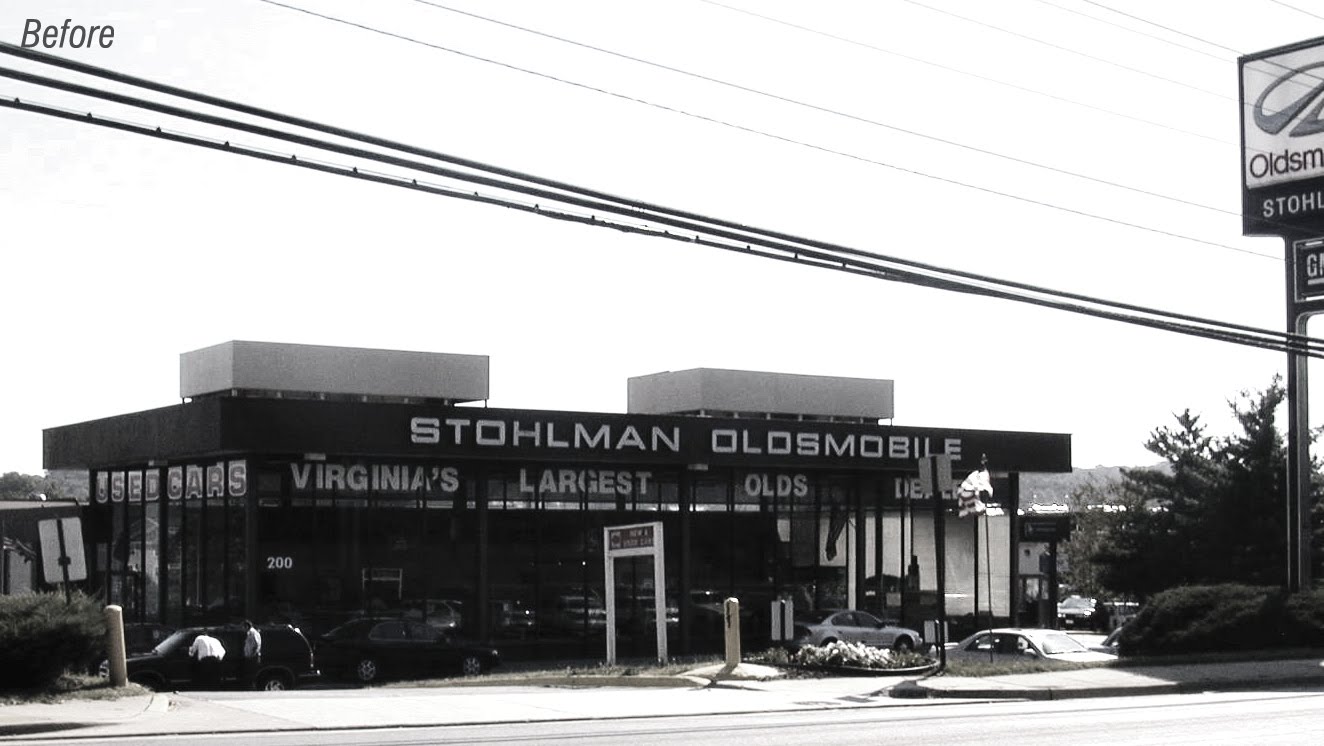
In 2004, when the time came to gild the proverbial lily, and with something close to 1,000 automotive facility designs in the firm’s fight book, Chris Lessard, Lori Hall and Hernani Codera of The Lessard Group took Mercedes-Benz’s branding philosophies out for a test drive when they designed a 27,000 s.f. Old Town Alexandria, Va. dealership at 200 S. Pickett Street, one that embraced both the product and the neighborhood. And they did it again this year as the facility experienced a renovation in a mid-Atlantic salute to the brand’s progressive, industrial, high-tech German image.


“Auto manufacturers create branding books so when you go to different dealerships, you can identify with some of the elements in each dealership,” Lessard said, noting that Autohaus is Mercedes-Benz’s image and branding program. But in a storied venue like Old Town, where historical parameters govern building design, applying branding principles such as Mercedes-Benz’s steely facades can be like walking a diplomatic tightrope at best. “As a firm, we do a lot of other things, not just auto dealerships,” Lessard said, emphasizing that zoning and entitlement work often follow suit, though Alexandria is one of the “tougher jurisdictions.”
“We also had to present some renderings to the residents,” said Hall, who is the firm’s director of automotive facility design, because they, too, were concerned with how it was going to look. They wanted to know what their view was going to be.”

The Demise of Mini-Me


The structure, which was built essentially to swallow and to some extent incorporate a small, deteriorating mid-century Oldsmobile dealership on the site, is wood and red brick (think: ubiquitous northern Virginia) with traditional detailing and arched windows. But because the city’s saga’d image has evolved and become less restrictive in the last six years, and in compliance with Mercedes-Benz’s current identity that sanctions exposed steel, a blue arcade, silver panels and blue columns with chrome caps, the architects were able to integrate these elements into the renovation.

According to Lessard, Autohaus examines each dealership and estimates the level of business it’s going to do. “With that, they give a very defined programming requirement that they want to have appropriate service and waiting areas,” he explained, noting they are adding more bays in Alexandria to deal with the dealership’s service component. “It’s very prescriptive,” he said, “especially with Mercedes, where you’re getting the high level of service for the consumer that either buys or services a car there, or while servicing a car, looks at a new car.” To that end, according to project manager Codera, the Old Town facility will also be able to accommodate 580 vehicles, up from 520, when the renovation is complete. “In the 1950s, you had auto sites that didn’t have a lot of cars on them, but that’s not how it works today,” Lessard said. “You have to count every square inch of the site to make sure you can meet the requirements of inventory.”


Message in a Building

In Silver Spring, Md., a roughly 60,000 s.f. two-story Mercedes-Benz dealership at 3301 Briggs Chaney Road, that actually turns a corner, careens toward a March, 2011 delivery date with LEED Gold looming. “At the time we were designing it (first submission was in 2008, though construction issues stalled the process), LEED wasn’t really a factor,” Hall said, referencing the firm’s best practices standards. But with Montgomery County’s current mandate for all new commercial construction to meet LEED certification requirements, and actual construction beginning just this year, energy efficient lighting comprised of both LED and CFL’s is just one component of the glass and steel building which, by its nature, will also utilize natural light.


Trumpeting Mercedes-Benz’s perspective on precision and luxury, and branding elements such as exposed steel, black high gloss tile and “beam outriggers” that reinforce the German industrial machine look all withstanding, the psychology of the Silver Spring facility will involve what the automotive company calls its “triad,” where the service area and lounge, parts accessory boutique and the showroom are all visible from the middle of the building.

“If I’m going to get my car serviced, I’m going to want to sit in this beautiful lounge and enjoy myself, wander through to accessories thinking about whether I want to get a new keychain or new wheels, and while there, I can be looking at all the brand new cars thinking maybe it’s time to upgrade,” Hall explained. In fact, when a new car decision is made, the new car delivery area, painted an effervescent yellow, is sited so that a new owner and family can be somewhat isolated from the throng (think: sort of a private screening), but other customers can also experience the “bragging rights” of the new owner driving away. In the service lounge, according to Codera, customers can actually see their car being serviced through glass that abuts the service bays. “It’s a retail selling process,” Lessard said in summary, “whether you’re servicing or buying a new car – it’s making you feel happy whatever you’re doing and making you want to come back.”


Speaking to any perceived constraints of working within the parameters of branding specifications, Lessard maintained that while the auto manufacturer has certain standards, they are not always precise and do allow for creativity and change over time. “You can be part of that change,” he said, affirming that as an architect, he’s “not necessarily into social engineering.

“I’m really trying to make sure the building is servicing the needs of whoever’s using it, whether it feels good inside, or whether it encourages someone to do something. That’s what this firm is about, so branding actually helps me,” Lessard said. “It makes clear what the program needs to be, and I can improve on the requirements by making the building even better. It really reinforces the message.”


Bottom 2 photos of Mercedes-Benz Annapolis.


Monday, August 9, 2010

Atlanta-based Post Properties announced last week that it will begin construction on phase two of its Carlyle Square apartment project in Alexandria. The development company is confident that they will find enough Metro riders to overcome area's traffic congestion and fill the new 344-unit apartment building. Each unit at 601 Holland Lane will average 906 s.f. of freshly designed contemporary interior space, located not far from Ballenger Avenue in the southeastern corner of the increasingly dense Carlyle neighborhood.

Total development costs are estimated to top out at $95 million. Post is expecting to benefit from cyclically low construction costs, and will bankroll the project using its unsecured revolving lines of credit, it reports. Post hopes to deliver the first apartments in the spring of 2012, a time which the company predicts will present favorable rental conditions.

Architect Sami Kirkdil of SK&I Architectural Design Group received praise and an award from Builder Magazine for his massing arrangement on Post's last Carlyle building, elegantly blending a rather large building into the roof-lines of its smaller surroundings. SK&I will again shoulder the design responsibilities for phase two of the Post Carlyle. The new building will consist of a 4-story structure abutted by a glowing 14-story tower of metal and illuminated glass intended to suggest a glowing lantern. The residencies will be amassed atop 425 below grade parking spaces.

Alexandria Virginia Real Estate Development News

Thursday, July 15, 2010

According to popular discourse, David Conrath has managed to meld tenets and technologies from "Planet of the Apes," ancient Egypt, an Antiguan monastery and 19th century prairie life into a sustainable formula that is catapulting Alexandria City Public Schools (ACPS) into the next generation, and the next, and maybe even the next.

Conrath, a free-associating kind of Captain Kirk of design and construction for ACPS, is ringmastering a sustainability makeover – or maybe more aptly a takeover – of ACPS’ 19 facilities, 17 of them schools. By his own admission, after four years at the helm, “…the road is littered with professionals – two or three civil engineers, an architect, and a couple of mechanical engineers – who didn’t get with the program and weren’t forward-thinking enough.”

In this case, the road to which Conrath refers is actually the asphalt parking lot that blankets TC Williams High School’s Minnie Howard campus. For the uninitiated, in Alexandria 9th graders are separated from sophomores, juniors and seniors, on their own campus, for what officials consider a pivotal year often fraught with transitional woes. While TC Williams High School was built a decade ago and achieved LEED Gold, the Minnie Howard campus was plagued by heating, cooling, and recycling failures, the detritus of the last energy crisis in the 1980s, and languished amidst mounting energy bills, insufficient classroom air and a Beatles-era Perkins diesel generator (what Conrath calls a “Planet of the Apes” scenario but which he has retained for emergencies “because the grid is pretty crappy in Alexandria”).

Hiring Dallas-based Energy Education Inc., a firm working with about 200 school systems across the country to facilitate energy modeling, according to Conrath, ACPS began by addressing the ‘80s answer to energy conservation. “In the 1980s, in our school system, they took out every fresh air intake for every classroom and bricked them up,” Conrath said, explaining that sometimes there’s an “unfortunate inverse relationship” between being green and indoor air quality – and energy savings. “To bring fresh air into the building costs a lot of money,” he added, noting that in order to save 16 percent of the energy bill back then, “not having to circulate, temper and condition fresh air was standard practice in the last energy crisis.” Unfortunately, the practice resulted in a lot of sleepy students and faculty, not to mention exceedingly high levels of classroom humidity and consequent “smelly, stinky problems,” according to retiring 9th grade teacher Mary Sue Garner, who said that even with an air conditioner, she had to keep the classroom door open.

Ground Beneath Their Feet

In a big picture effort to reverse the problem and address pervasive heating/cooling issues at Minnie Howard, and to align the school with 21st century sustainability, Conrath began the geothermal process by inventing methods to plant 64 wells, 310-feet deep, drilling through the asphalt parking lot without lifting it into the air (he admits the first couple of tries did just that). Drilling through the next layer - which was mud - ensued, as did tackling erosion sediment control and also installing a special muffling device so the work could continue throughout the school year. The job became a kind of choreography during the day, according to Conrath, because of the active bus loop meaning the work would have to start and stop and start again with an eye to bus schedules. The wells, which contain 10-inch diameter special piping with a silver nitrate lining (a natural biocide that precludes mold), would store air drawn in from the outside by a 10 kilowatt photovoltaic solar array, and keep it at a constant fifty-degree ground temperature. “If we draw in air at 95 degrees with 90 percent humidity (by the array), and it comes in at 80 degrees and 60 percent humidity, we get a 15-degree drop in temperature,” Conrad explained, noting that in winter, a 15-degree boost is expected. The solar array, in plain sight for educational purposes when you enter the parking lot (it also serves to shield southern exposure windows providing cooling for those classrooms), is linked to a variable zone refrigerant system, which serves to influence temperature even more when necessary.

Roof Over Their Head

With a green roof installed initially on a test basis on one-third of the footprint of the school, energy bills compared from a snowy, almost sunless January, 2010, to the same month of the previous year yielded more than $5000 in energy savings. A 5,000 sf green roof, visible from the road because of the way school is sited, is also projected for the school instead of the current tar roof, which will slow down storm water, filter and purify solids, and change nitrates and chemical properties of the water. It will also naturally insulate the roof, much like a 19th century prairie sod house.

“My first day on this campus I felt like Jethro Bodine in ‘The Beverly Hillbillies,’” Conrath quipped about the character who was always dazed and confused about creature comforts and accruing technology. “I was taking some time to wrap my head around the concept of putting Astroturf on the field and grass on the roof.”

Walls That Don’t Contain Them

In the bowels of the school, in what the crew of the Starship Enterprise might perceive as the command center (actually it’s the old mechanical room), the makings of a “Greenovation lab” emerge, a term coined by ACPS special projects assistant Grace Taylor. The kid-safe space replete with gauges, real time Web data, dashboards and other educational components will serve as an education center, maybe even imagination central, both for 9th graders and to entice some of the older children who have dropped out to return. The students will benefit from “green collar training,” or training in technology disciplines that don’t even exist right now like working with solar arrays, Conrath said, but which are “fast coming online.” In fact, at present, every system in every school can be directed from a laptop at Starbuck’s, Conrath noted.

Windows on their World

According to Conrath, among the many impetuses for the greening of ACPS was a series of incidents three years ago at John Adams Elementary School, located in an area where the grid is stretched thin. “We kept losing power and had to close the school,” Conrath said, “because there were no windows in the bathrooms.” Unable to afford an emergency generator, Conrath came up with a 21st century application of an ancient Egypt-based solution called a sun tunnel.

“While they didn’t have Fresno lenses and plastic in Egypt, the concept is the same where light is gathered through the lense’s multiple prisms (the lense is a small globe that sits on a white roof like a lighthouse),” Conrath explained. It is then sent down a mirrored tube into a 2’x2’ plastic light diffuser. “People never even knew there wasn’t a light in there,” he said.

At Polk Elementary School, seven emerging technologies including geothermal wells, a variable zone refrigerant system, solar renewable energy, photovoltaic energy, daylight harvesting, green roofs and an eco-air system grounded to the air/heat exchange system carry with them the distinction of making Polk the only elementary school in the country to merge these systems. The technology at Polk was used in the 1500s, Conrath explained, adding that he’d seen it exemplified at an Antiguan monastery where a catacombed basement was designed like a nautilus shell. When the wind blew, cold air from downstairs was rolled up through the monastery, exhausted and then emitted.

Citing a fiduciary responsibility to taxpayers and a dream way into the future to be off the grid, Conrath, who has a Masters degree in industrial design from RISD, said ACPS is trying to adopt Alexandria’s comprehensive Eco-City policy, implementing all of its projects. “It makes (progressive) San Francisco look archaic,” he said, noting the projects include water conservation, daylight harvesting, vegetative (or green) roofs and low-albedo finishes such as white roofs to reflect the heat. “As a school system, we’ve increased our footprint about 25 percent over the last 10 years but we’ve only increased our energy consumption by 10 percent,” he stated, with all that implies. “Nothing is as green as money.”