Washington D.C. real estate development news
Showing posts with label Torti Gallas. Show all posts
Friday, August 31, 2012
9:14 AM
Unknown
Washington D.C. real estate development news
Monday, April 16, 2012
2:50 PM
Unknown
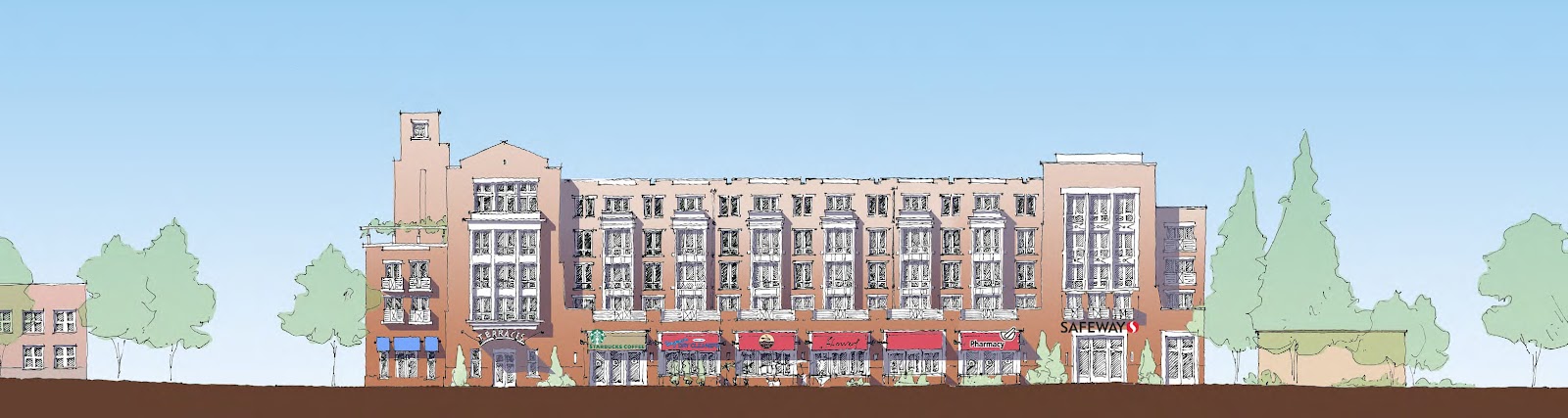
Yet another version of the redeveloped Safeway in Tenleytown could be in the works if the Washington Metro Area Transit Authority Board approves a proposal to sell an adjacent .25-acre site to Clark Realty Capital. Clark offered to purchase the "chiller site" as an addition to the Safeway redevelopment plan that includes residential units above the new grocery store.

For WMATA, the purchase is a chance to repurpose underutilized land, get a new air conditioning unit for two Metro stations, and possibly bank extra cash. If the sale goes through, Clark will develop the land and put a new chiller plant in the building. The air conditioner for the Friendship Heights and Tenleytown Metro stations is already about halfway through its 20-year life cycle.
“This is an opportunity for us to get some value from the real estate holdings while improving our service,” said Steve Teitelbaum, senior real estate adviser at WMATA.
For Clark, purchasing the extra land means a continuous street front on Wisconsin Avenue and more space for development by increasing the lot to 2.75 acres from the roughly 2.5 acres it now covers. Clark's John Sunter said additional residential or retail space will be created "generally in proportion to the increased size of the site."

Current plans show four floors of residential space above the new Safeway on 42nd Street. Both the lot and the building slope back toward 43rd Street. Other residential units include townhouses and free-standing houses around the property. Sunter said the team is working on revised plans using the WMATA lot and that they "look forward to sharing any changes with the community at the appropriate time."
![]() |
| Elevation along Davenport Street |
Jonathan Bender, chairman of Advisory Neighborhood Commission (ANC) 3E, said that while
some residents' concerns were addressed in the revised plans, there still was room for improvement regarding the impact of increased density on the community."I, and I believe most of my fellow commissioners, do not object per se to the level of density Safeway/Clark proposes," he said in an email response. "Instead, several of us are concerned that Safeway has not committed to the steps necessary to minimize the burden that such density could occasion. Perhaps the biggest concern is parking in the neighborhood."
He said the ANC has asked that the new residents be ineligible for Residential Parking Permits (RPPs). The project is intended to encourage public transportation in lieu of using
personal vehicles.
personal vehicles.But the ANC likely would support using the WMATA site, especially if it facilitates the incorporation of other ANC suggestions.
"I and other commissioners actually suggested that Safeway/Clark look into purchasing this property long before we knew they had been talking about doing so with WMATA, and perhaps before they actually had done so," Bender said. "I would especially like to see the WMATA plot used in part for additional retail offerings and enhancements to the streetscape."
The WMATA board will vote on the sale proposal April 26.
Washington, D.C. real estate development news
Wednesday, April 11, 2012
6:00 AM
Unknown
Emory Beacon of Light Inc. requested a two-year zoning variance extension Tuesday morning for development of the Beacon Center, the mixed-use project planned on Georgia Avenue in Brightwood.
The group, a community development organization tied to Emory United Methodist Church, first received government approval in early 2010. But construction has not yet started on the $36 million project that will include church, residential, retail and community development space.
Hazel Broadnax, President of Emory Beacon of Light, said the group "had to change architects." Torti Gallas and Partners took over design duties started by PGN Architects.The project website states: "We have new architects with a strong history of affordable housing and community transformation projects across the country and in Washington, DC."
Changing architecture firms contributed to the delay and need for an extension of the approved zoning variance.
Initial plans called for a 2-story gymnasium, but Broadnax said funding shortfalls scrapped those plans, making way for additional housing and services to better serve the veteran community.
Emory Beacon of Light still is working to secure $2 million for the project. The group has struggled with funding along the way, but Broadnax said the group now just has a $2 million "funding gap."
Plans in 2010 called for 24 units of transitional space to help the homeless work toward permanent residency, 34 units reserved for senior citizens, 17 units for veterans and 16 affordable rentals.
Washington, D.C., real estate development news
The group, a community development organization tied to Emory United Methodist Church, first received government approval in early 2010. But construction has not yet started on the $36 million project that will include church, residential, retail and community development space.
Hazel Broadnax, President of Emory Beacon of Light, said the group "had to change architects." Torti Gallas and Partners took over design duties started by PGN Architects.The project website states: "We have new architects with a strong history of affordable housing and community transformation projects across the country and in Washington, DC."
Changing architecture firms contributed to the delay and need for an extension of the approved zoning variance.
![]() |
"When they were getting the plans ready for the next phase of the project, there were some things that had to be done that were not completed by the prior architects," Broadnax said. "Plus, our zoning variance was scheduled to expire this year. So we needed a two-year extension to get everything done and get plans to the contractor."
Despite the new architecture firm, exterior plans for the building remain the same. New construction will surround the existing church as previously planned. But the interior changed a bit.
Emory Beacon of Light still is working to secure $2 million for the project. The group has struggled with funding along the way, but Broadnax said the group now just has a $2 million "funding gap."
According to the project website, the group “will be simplifying the project and building in two phases.” It now comprises 5,700 s.f. of retail space; 10,600 s.f. of office, meeting and classroom space; and 96 parking spaces. Both buildings contain housing for a total of 15 transitional family housing units, 45 affordable family housing units, 32 permanent supportive housing for veterans, and 17 transitional housing units for single men. 

Broadnax said the project now is in the design development phase, and everyone is working to get the plans to construction contractor Bozzuto. Emory Beacon of Light also partnered with development consultant Northern Real Estate Urban Ventures (NREUV) for the project.
Broadnax said she hopes for a groundbreaking this year with completion 18 to 24 months later.
Washington, D.C., real estate development news
Thursday, April 5, 2012
2:29 PM
Unknown
Two open lots in Arlington will start bustling within the next two weeks as work begins on two long-awaited mixed-use developments between the Rosslyn and Courthouse Metro stations.
After many months of predicting an "imminent" groundbreaking at the adjacent pair of now-vacant lots, Elm Street Development plans to begin utility work next week at 2001 Clarendon Blvd., Elm Street Vice President James Mobley said in an email. Next door at 1919 Clarendon Blvd. (the Hollywood Video site), crews were told to proceed, with work getting underway within two weeks, sources at USAA Real Estate said.
Arlington County records show USAA received a sheeting a shoring permit March 28 but still must revise plans to get additional construction permits for the residential and retail development at 1919 Clarendon Blvd., previously 1900 Wilson Blvd.
| Rendering of 1919 Clarendon Blvd. |
"We have submitted for Footing to Grade Permit and addressed comments on the Sheeting and Shoring Plans," Mobley said in the email. "Other than addressing County comments the building is unchanged."
![]() |
| Rendering of 2001 Clarendon Blvd. |
Mobley did not respond to a question asking why the project has been delayed. USAA said its project is moving forward as planned. However, both companies have said that construction was at hand at least since 2010.
With an expected delivery date in 2014, 2001 Clarendon Blvd. will be home to a 6-story mixed-use development with 154 apartments and approximately 30,000 s.f. of retail space. WDG Architecture designed the building S. E. Foster will construct. .
USAA will bring a 5-story mixed-use development with 198 residential units and 24,657 s.f. of retail space to 1919 Clarendon Blvd. USAA bought the site and plans from Zom Inc.in 2001. Torti Gallas designed the project that Harkins will build.
Arlington, VA real estate development news
Tuesday, February 22, 2011
7:19 AM
Unknown
One of Arlington's most stubbornly static development sites - a superblock of three stagnant development parcels at the Courthouse Metro station - is finally ready to start construction in what could be a fraternity of development initiatives. Developers of the 1800, 1900 and 2000 blocks of Wilson Boulevard, all located on the same block, have been working separately for years to build large, mixed-use projects on their respective sites, and now the latter two say they will start construction this year for vast amounts of retail, housing, and office space, broken up with a new street between them.

Elm Street Development plans to start its construction on 2000 Wilson Boulevard (formerly the Taco Bell and Dr. Dremo's site), known now as 2001 Clarendon, with 30,000 s.f. of retail space and 154 residential
units, while USAA, which purchased the 1900 block of Wilson Boulevard late last year, plans to start work this fall on a mixed-use, predominantly residential project. Working out approvable developments on both sites required land swapping and an endowment of land to Arlington to extend Troy Street, connecting Wilson and Clarendon Boulevards. Meanwhile, developers at the eastern end of the superblock on Rhodes Street are still vying to get financing to double the size of the office space and integrate retail.
2000 Wilson
The stuttering progression
at 2001 Clarendon was initially planned to begin in late 2007 as a condominium, but in 2008 switched to apartments (in theory), shooting for a 2010 completion. In early 2010 Elm Street VP Jim Mobley said the team was again "looking at" the concept of condos, "financing dependent." With financing now in place (underwritten as apartments), construction is near, with the likely chance of condo conversion down the road. Retail space will front 3 streets, subdivided into small storefronts. Because of Elm Street's rejiggering of the plans, at Arlington's suggestion, no permits have been issued, but sources for the project say work is expected to commence late this year.
George Dove, Managing Principal at WDG Architecture, which designed the 6 story "extremely contemporary" building, notes the challenges facing the climbing site. "From a zoning standpoint, between Courthouse and Rosslyn, you have a sequence of height limits, and you have elevation changes, so it has a series of levels that drop-off as you move down the street, like stair-steps. This had alot to do with driving the design." Besides shooting for basic LEED certification, an Arlington requirement, 2001 Clarendon will incorporate a series of green roofs. "This is the antitheses of the high-rise, urban, compact residential project. It stretches out over a much larger floorplate. That gives alot of rooftop areas at different levels, it is definitely not a boring facade," said Dove.
1900 Wilson
Across the (not yet built) street, USAA has purchased 1900 Wilson Boulevard, along with its plans for a 5-story mixed-use residential building. USAA bought the Hollywood Video site from Zom, Inc., which had already birddogged plans to construct residences through Arlington's approval process. USAA will retain Zom as a fee developer to build out the project. Torti Gallas designed the more urban seeming structures with large retail spaces along Clarendon Boulevard and live/work spaces along Wilson Boulevard.
Sources involved in the development say no dates have been set, but that work is "on target" to materialize this year, and Hailey Ghalib of USAA says the the developer expects to build in the third quarter of this year and is working with Harkins Builders on pre-construction issues,
but has not yet signed a construction contract nor obtained construction permits. Construction is expected to last 22 months.
1800 Wilson
The lone holdout at this point is the eastern end of the block, slated to demolish Rhodeside Grill and Il Radicchio to more than double the office space used by the National Science Teachers Association. The NSTA has teamed with developer DRI to expand their Arlington headquarters at 1840 Wilson, with an approved site plan in hand. NSTA hopes to build a 107,000 s.f. office building with 10,000 s.f. of retail, taking up an adjacent surface parking lot. The site plan was initially approved in November 2005, amendments were approved in July 2008 and November 2008 to resolve façade and parking issues, but the project is on hold pending financing, which the team is "working very hard" to secure, of course. The NSTA has already contracted Davis Carter Scott as the architect and DPR Construction Company as the general contractor, if and when the bankers come to the rescue.
As if that weren't enough, work is now underway next door in the 1700 block of Wilson Boulevard, where Skanska is building a 5 story office building. Get ready for a loud but productive year, and lots of cranes.
Arlington Virginia real estate development news
Elm Street Development plans to start its construction on 2000 Wilson Boulevard (formerly the Taco Bell and Dr. Dremo's site), known now as 2001 Clarendon, with 30,000 s.f. of retail space and 154 residential
2000 Wilson
The stuttering progression
at 2001 Clarendon was initially planned to begin in late 2007 as a condominium, but in 2008 switched to apartments (in theory), shooting for a 2010 completion. In early 2010 Elm Street VP Jim Mobley said the team was again "looking at" the concept of condos, "financing dependent." With financing now in place (underwritten as apartments), construction is near, with the likely chance of condo conversion down the road. Retail space will front 3 streets, subdivided into small storefronts. Because of Elm Street's rejiggering of the plans, at Arlington's suggestion, no permits have been issued, but sources for the project say work is expected to commence late this year.George Dove, Managing Principal at WDG Architecture, which designed the 6 story "extremely contemporary" building, notes the challenges facing the climbing site. "From a zoning standpoint, between Courthouse and Rosslyn, you have a sequence of height limits, and you have elevation changes, so it has a series of levels that drop-off as you move down the street, like stair-steps. This had alot to do with driving the design." Besides shooting for basic LEED certification, an Arlington requirement, 2001 Clarendon will incorporate a series of green roofs. "This is the antitheses of the high-rise, urban, compact residential project. It stretches out over a much larger floorplate. That gives alot of rooftop areas at different levels, it is definitely not a boring facade," said Dove.
1900 Wilson
Across the (not yet built) street, USAA has purchased 1900 Wilson Boulevard, along with its plans for a 5-story mixed-use residential building. USAA bought the Hollywood Video site from Zom, Inc., which had already birddogged plans to construct residences through Arlington's approval process. USAA will retain Zom as a fee developer to build out the project. Torti Gallas designed the more urban seeming structures with large retail spaces along Clarendon Boulevard and live/work spaces along Wilson Boulevard.
Sources involved in the development say no dates have been set, but that work is "on target" to materialize this year, and Hailey Ghalib of USAA says the the developer expects to build in the third quarter of this year and is working with Harkins Builders on pre-construction issues,
1800 Wilson
The lone holdout at this point is the eastern end of the block, slated to demolish Rhodeside Grill and Il Radicchio to more than double the office space used by the National Science Teachers Association. The NSTA has teamed with developer DRI to expand their Arlington headquarters at 1840 Wilson, with an approved site plan in hand. NSTA hopes to build a 107,000 s.f. office building with 10,000 s.f. of retail, taking up an adjacent surface parking lot. The site plan was initially approved in November 2005, amendments were approved in July 2008 and November 2008 to resolve façade and parking issues, but the project is on hold pending financing, which the team is "working very hard" to secure, of course. The NSTA has already contracted Davis Carter Scott as the architect and DPR Construction Company as the general contractor, if and when the bankers come to the rescue.
As if that weren't enough, work is now underway next door in the 1700 block of Wilson Boulevard, where Skanska is building a 5 story office building. Get ready for a loud but productive year, and lots of cranes.
Arlington Virginia real estate development news
Thursday, October 14, 2010
5:32 AM
Unknown
A Street Sense article recently expressed worry over the impending closing of the La Casa homeless shelter at 1436 Irving Street, NW and the prospect of 72 extra homeless men hitting the streets just in time for hypothermia season. The emptying shelter will in fact give way to construction crews and wrecking balls, as the property is set to feature a 143-unit addition to Donatelli Development's adjacent Highland Park apartment building, as well as brand new 82-bed community based residential facility.
Although the development team successfully obtained a two-year PUD extension from the Zoning Commission earlier this summer, citing (surprise) difficulty securing financing giving the economic downturn, the District will still follow through with the closing of La Casa. Trailers will be removed by November 1st, paving the way for construction to begin shortly after. Reggie Saunders of the DC Department of Human Services confirmed that the shelter will officially close this Friday, October 15th. With PUD extension in hand, developers will have until June 27, 2012 to file for a building permit, and until June 27, 2013 to commence construction, but Chris Donatelli, President of Donatelli Development, insists that the soon-to-begin environmental remediation work and demolition will quickly give way to actual construction in the coming months.
The news does not come as a surprise to Steven Jackson, Program Coordinator at La Casa Shelter, who says he's been "operating under the assumption that the shelter will shut down this Friday." Jackson says that plans have been arranged to accommodate current shelter residents by either placing them in "permanent supportive housing" or "reassigning them to alternative emergency shelters." Jackson confirmed that a few of the men had been reassigned to the La Casa Transitional Rehabilitation Program (TRP), a more comprehensive six-month program that "provides temporary residential services for homeless men to help them to achieve self sufficiency."
Originally approved as an 86-foot, 69 unit-addition, Zoning granted the development team a modification to their PUD late last week, accepting the applicant's plea to expand their residential plans from the original 69 to 143 units and push the building up to 90 feet. Additionally, a setback penthouse level will rise nine feet atop the roof line. Twenty percent of the new apartments will be "affordable," marketed at 80% AMI. The modification also permits architects to redesign the exterior facades to more smoothly blend the addition with the existing Highland Park apartment building. The newly amended PUD also rids developers of their parking space obligation, as future residents will be allotted space in the already constructed below-grade garage next door. The new Highland Park West apartment tower will front Irving Street and be directly connected to the original Highland Park. The new shelter residential facility will occupy the back half of the lot, and will stand separately from the apartment buildings.
Torti Gallas, designers of the adjacent Highland Park apartments, have passed off architectural duties to Bethesda's GTM Architects for the new addition. Initial designs which included a lily-like glass building called the Calla Lily, a design that would have been a significant departure from Highland Park and from the architectural standards of Columbia Heights, has been scratched. Instead of creativity and innovation, architects have tapped their best tracing abilities, as "the new building will look like an exact, matching extension of Highland Park," Donatelli explained. But hey, why mess up a good thing. Highland Park has been a popular residential success since it opened in 2008, and Donatelli confirms that the last retail space has just been leased, soon to feature a brand new sports bar named Lou's Bar and Grill.
It remains unclear how the District will foot the bill for the new shelter, or who will operate it once it's reopened, says Stephen Jackson of La Casa. Donatelli doesn't know either: "We're responsible for the demolition and the design plans, after that it's all on them." Them being the District government, and Lydia DePillis's reporting at City Paper makes it pretty clear that whatever money had been previously set aside for a new La Casa is now lost or spent, and one way or the other, unaccounted for. If and when the new La Casa is made a reality, the building will be quite an upgrade from the current mess of trailers that occupy the property. The planned shelter will not serve "emergency" needs, sandwiching 15 men into bunk-lined trailers, but instead feature private one-bed apartments, better suited to rehabilitate homeless men with drug and alcohol addictions and mental health problems. The Coalition for the Homeless, a nonprofit that currently operates the La Casa shelter, seems optimistic about its continued involvement at the Columbia Heights location, as its website reads: "The La Casa TRP was temporarily relocated to 1131 Spring Road, NW by the District government until the NEW state of the art La Casa Multicultural Center is built at its current location on 1436 Irving Street, NW." But then you would have known some of this had you shelled out the $1 for Street Sense last week.
DC Real Estate Development News
Although the development team successfully obtained a two-year PUD extension from the Zoning Commission earlier this summer, citing (surprise) difficulty securing financing giving the economic downturn, the District will still follow through with the closing of La Casa. Trailers will be removed by November 1st, paving the way for construction to begin shortly after. Reggie Saunders of the DC Department of Human Services confirmed that the shelter will officially close this Friday, October 15th. With PUD extension in hand, developers will have until June 27, 2012 to file for a building permit, and until June 27, 2013 to commence construction, but Chris Donatelli, President of Donatelli Development, insists that the soon-to-begin environmental remediation work and demolition will quickly give way to actual construction in the coming months.
The news does not come as a surprise to Steven Jackson, Program Coordinator at La Casa Shelter, who says he's been "operating under the assumption that the shelter will shut down this Friday." Jackson says that plans have been arranged to accommodate current shelter residents by either placing them in "permanent supportive housing" or "reassigning them to alternative emergency shelters." Jackson confirmed that a few of the men had been reassigned to the La Casa Transitional Rehabilitation Program (TRP), a more comprehensive six-month program that "provides temporary residential services for homeless men to help them to achieve self sufficiency."![]() |
| Old rendering |
Torti Gallas, designers of the adjacent Highland Park apartments, have passed off architectural duties to Bethesda's GTM Architects for the new addition. Initial designs which included a lily-like glass building called the Calla Lily, a design that would have been a significant departure from Highland Park and from the architectural standards of Columbia Heights, has been scratched. Instead of creativity and innovation, architects have tapped their best tracing abilities, as "the new building will look like an exact, matching extension of Highland Park," Donatelli explained. But hey, why mess up a good thing. Highland Park has been a popular residential success since it opened in 2008, and Donatelli confirms that the last retail space has just been leased, soon to feature a brand new sports bar named Lou's Bar and Grill.
It remains unclear how the District will foot the bill for the new shelter, or who will operate it once it's reopened, says Stephen Jackson of La Casa. Donatelli doesn't know either: "We're responsible for the demolition and the design plans, after that it's all on them." Them being the District government, and Lydia DePillis's reporting at City Paper makes it pretty clear that whatever money had been previously set aside for a new La Casa is now lost or spent, and one way or the other, unaccounted for. If and when the new La Casa is made a reality, the building will be quite an upgrade from the current mess of trailers that occupy the property. The planned shelter will not serve "emergency" needs, sandwiching 15 men into bunk-lined trailers, but instead feature private one-bed apartments, better suited to rehabilitate homeless men with drug and alcohol addictions and mental health problems. The Coalition for the Homeless, a nonprofit that currently operates the La Casa shelter, seems optimistic about its continued involvement at the Columbia Heights location, as its website reads: "The La Casa TRP was temporarily relocated to 1131 Spring Road, NW by the District government until the NEW state of the art La Casa Multicultural Center is built at its current location on 1436 Irving Street, NW." But then you would have known some of this had you shelled out the $1 for Street Sense last week.
DC Real Estate Development News
Monday, August 30, 2010
10:03 AM
Unknown
Developers of North Bethesda, having just completed the county's tallest residential building and the Pike's largest recent project, are hoping for an encore. Now nearing completion of the North Bethesda Market
, developer JBG has begun courting the community for a second phase, seeking an increase in density for new office and residences that will produce demand for the 200,000 s.f. of retail built in the first phase.
Developers of Rockville Pike in North Bethesda have long hoped that if development continues, and smart urban planning matches pace, the congested corridor might make the triple-jump to a walkable urban district. JBG unveiled initial plans to the community last week, still just conceptual, that would add 745,000 s.f. of development with a 40% increase in density to the block just north of its current project. JBG isn't the only player in the game, as the White Flint Sector Plan highlights several other major developments in the area, including Federal Realty's "Mid-Pike Plaza," and LCOR's White Flint development. JBG submitted initial plans to the Montgomery National Capital Park and Planning Commission early on Friday the 27th, depicting additional retail fronting Rockville Pike and a series of residences on the block behind it. Approval could take anywhere from 18 to 24 months, so construction on the newest phase is not expected to start until late 2012 or early 2013.
After announcing earlier this summer that Florida-based restaurants Season 52 and Dolcé Amoré Café, along with furniture juggernauts Arhaus, will join Whole Foods and L.A. Fitness at the round table of tenants in the nearly completed North Bethesda Market, JBG hopes to broaden the scope of NoBe (or NoBeMa, take your pick) with an array of new residencies, office space, and expanded retail options. NoBe sales representatives said they are hoping Whole Foods will open for shoppers by spring of next year.
The new site extends the Market north to Nicholson Lane, replacing three low density 40-year-old office and retail buildings, and one new office and retail building. Torti Gallas will stay on as the planning architect. One of the goals in maintaining some sort of unifying theme within the development is the extension of Paseo north into Phase II.
Paseo is the "concept of an intimate, pedestrian-oriented, retail lined street" that is meant to tie together the residential and commercial aspects of the project.
Senior VP of Marketing Matthew Blocher depicts the community feedback so far as positive, as developers expect the enthusiasm surrounding the opening of the first phase to carry over as they continue to unveil second stage plans. But one of the obstacles to moving forward with redevelopment is getting the community and county officials on-board with the increased density. Developers say a minimum base density of 3.5 FAR is necessary
to buoy the requisite investment, and appropriate given the proximity to the White Flint Metro, but authors of the White Flint Sector Plan currently recommend 2.5 FAR. County officials have been keen on spurring the kind of redevelopment that JBG is pursuing across the region, but have also been conscious of just how fast that growth is developed.
Washington D.C. Real Estate Development News
, developer JBG has begun courting the community for a second phase, seeking an increase in density for new office and residences that will produce demand for the 200,000 s.f. of retail built in the first phase.Developers of Rockville Pike in North Bethesda have long hoped that if development continues, and smart urban planning matches pace, the congested corridor might make the triple-jump to a walkable urban district. JBG unveiled initial plans to the community last week, still just conceptual, that would add 745,000 s.f. of development with a 40% increase in density to the block just north of its current project. JBG isn't the only player in the game, as the White Flint Sector Plan highlights several other major developments in the area, including Federal Realty's "Mid-Pike Plaza," and LCOR's White Flint development. JBG submitted initial plans to the Montgomery National Capital Park and Planning Commission early on Friday the 27th, depicting additional retail fronting Rockville Pike and a series of residences on the block behind it. Approval could take anywhere from 18 to 24 months, so construction on the newest phase is not expected to start until late 2012 or early 2013.
After announcing earlier this summer that Florida-based restaurants Season 52 and Dolcé Amoré Café, along with furniture juggernauts Arhaus, will join Whole Foods and L.A. Fitness at the round table of tenants in the nearly completed North Bethesda Market, JBG hopes to broaden the scope of NoBe (or NoBeMa, take your pick) with an array of new residencies, office space, and expanded retail options. NoBe sales representatives said they are hoping Whole Foods will open for shoppers by spring of next year.The new site extends the Market north to Nicholson Lane, replacing three low density 40-year-old office and retail buildings, and one new office and retail building. Torti Gallas will stay on as the planning architect. One of the goals in maintaining some sort of unifying theme within the development is the extension of Paseo north into Phase II.
Paseo is the "concept of an intimate, pedestrian-oriented, retail lined street" that is meant to tie together the residential and commercial aspects of the project.
Senior VP of Marketing Matthew Blocher depicts the community feedback so far as positive, as developers expect the enthusiasm surrounding the opening of the first phase to carry over as they continue to unveil second stage plans. But one of the obstacles to moving forward with redevelopment is getting the community and county officials on-board with the increased density. Developers say a minimum base density of 3.5 FAR is necessary
to buoy the requisite investment, and appropriate given the proximity to the White Flint Metro, but authors of the White Flint Sector Plan currently recommend 2.5 FAR. County officials have been keen on spurring the kind of redevelopment that JBG is pursuing across the region, but have also been conscious of just how fast that growth is developed.Washington D.C. Real Estate Development News
Thursday, July 29, 2010
8:38 AM
Unknown
Already a major player in the District's real estate development game, B.F. Saul will now head a team of developers charged with bringing a mixed-use project near the Wheaton Metro station to life. This is just another materialization of a well-established effort by WMATA and its Director of Real Estate Steven Goldin to promote increased density, mass-transit-directed residential, retail, and office space through the Metro's Joint Development Program. "Selection of the B.F. Saul team for the Wheaton redevelopment project mirrors the successful strategy Montgomery County employed with Silver Spring," Montgomery County Executive Isiah Leggett said. The parcel is part of 10 that were offered up as development opportunities just last January.
The new development will certainly help address many of goals set out by Wheaton Central Business District and Vicinity Sector Plan, including their hopes to: "Reinvigorate Wheaton’s downtown by creating a walkable community with a distinct identity; create a vibrant mix of jobs and housing; design quality public spaces inviting to pedestrians; and foster an environmentally sustainable community." Sounds delightful. Developers will also be expected to do all of the above while "preserving Wheaton’s ethnic diversity." The original plan was laid out in 1990, before the red line had surfaced in Wheaton. Since 2006 the Maryland-National Capital Park and Planning Commission (M-NCPPC) has taken it upon themselves to update the plan; the augmented plan is to be unveiled at a Montgomery Planning Board public hearing today.
While Metro has successfully completed a total of 21 transit oriented development projects so far, including notable Maryland-based developments such as Bethesda Metro Center, Grosvenor, Twinbrook and Wheaton (east), others like Greenbelt Venture's plans around the Greenbelt stations have wallowed in the rubble of inaction for years; just this year plans set for the area surrounding the Largo station were put on hold after the group of developers filed for bankruptcy.
In an effort to make this 8.2 acres only one working part of a more comprehensive and expansive redevelopment of downtown Wheaton, B.F. Saul will look to cooperate with existing local businesses and land owners such as the Westfield Wheaton Shopping Center to peacefully incorporate the new projects into the established community.
Wheaton was listed by Governor Martin O'Malley as one of the initial projects in a newly unveiled state Transit-Oriented Development (TOD) program, which will continue to encourage similar developments by bolstering them with funding, tax credits and other financial incentives and tools.
B.F. Saul will spearhead a team that includes Silver Spring-based Torti Gallas and Partners Inc. as lead design architect, as well as Rockville-based Loiederman Soltesz Associates Inc. as civil engineers, responsible for levelheadedly carrying out the architectural plans.
The Wheaton project will be the beneficiary of $200,000 in planning funds, compliments of the deep-pocketed Maryland Transportation Department.
Wheaton, Maryland real estate development news
The new development will certainly help address many of goals set out by Wheaton Central Business District and Vicinity Sector Plan, including their hopes to: "Reinvigorate Wheaton’s downtown by creating a walkable community with a distinct identity; create a vibrant mix of jobs and housing; design quality public spaces inviting to pedestrians; and foster an environmentally sustainable community." Sounds delightful. Developers will also be expected to do all of the above while "preserving Wheaton’s ethnic diversity." The original plan was laid out in 1990, before the red line had surfaced in Wheaton. Since 2006 the Maryland-National Capital Park and Planning Commission (M-NCPPC) has taken it upon themselves to update the plan; the augmented plan is to be unveiled at a Montgomery Planning Board public hearing today.
While Metro has successfully completed a total of 21 transit oriented development projects so far, including notable Maryland-based developments such as Bethesda Metro Center, Grosvenor, Twinbrook and Wheaton (east), others like Greenbelt Venture's plans around the Greenbelt stations have wallowed in the rubble of inaction for years; just this year plans set for the area surrounding the Largo station were put on hold after the group of developers filed for bankruptcy.
In an effort to make this 8.2 acres only one working part of a more comprehensive and expansive redevelopment of downtown Wheaton, B.F. Saul will look to cooperate with existing local businesses and land owners such as the Westfield Wheaton Shopping Center to peacefully incorporate the new projects into the established community.
Wheaton was listed by Governor Martin O'Malley as one of the initial projects in a newly unveiled state Transit-Oriented Development (TOD) program, which will continue to encourage similar developments by bolstering them with funding, tax credits and other financial incentives and tools.
B.F. Saul will spearhead a team that includes Silver Spring-based Torti Gallas and Partners Inc. as lead design architect, as well as Rockville-based Loiederman Soltesz Associates Inc. as civil engineers, responsible for levelheadedly carrying out the architectural plans.
The Wheaton project will be the beneficiary of $200,000 in planning funds, compliments of the deep-pocketed Maryland Transportation Department.
Wheaton, Maryland real estate development news
Wednesday, July 21, 2010
9:05 AM
Unknown
It's back to the drawing board for developers and architects working on Gary Rappaport's H Street redevelopment project. The Rappaport Companies' Parcel Seven Associates, LLC has been planning a large mixed-use redevelopment project running on the south side of H Street between 8th and 10th for over three years now. The rather enormous project, stretching two full blocks and replacing an outmoded single-story shopping strip, is expected to begin work on part of the 52,000 s.f. of retail and 400-odd residences within about two years, but save the 2nd half for much later. Developers endured the requisite series of conversations, meetings, and compromises, and were finally able to bring both DDOT and the ANC (6A and 6C) on board. But the Zoning Commission was not entirely wooed by the long line of witnesses pleading for approval of the obligatory zoning change at Monday evening's public hearing, and unanimously decided to delay final action until September 27th. This gives the architects and developers until Friday, September 3rd to officially respond to requests made by the Zoning Commission, and opponents of the project until September 10th to retort and fault Rappaport's modifications.
There were a number of minor issues with the plan in the eyes of the Commission, but the major hold up was the appearance of the project's closest neighbor in opposition to the project. This was not the first time developers had heard this family's concerns, and Rappaport insisted that they had labored to accommodate the neighbor's concerns about building height and traffic flow. But the strong reservations communicated by the 8th street neighbor were not mitigated to the extent the Commission expected, so Zoning requested more careful consideration of their concerns, particularly the family's anxiety over the likely increase in large trucks turning into the alley around the corner of their home.
One Zoning member requested that the architects refine the pavilion design on the opposite corner, at 10th and H Street, to generate a bolder and more interesting beginning to the rest of the building, while also tying together and re-enforcing the entirety of the design. "It lacks the kind of stylings and flavor of the rest of the building," he lamented. Another panel member was disappointed that the amenities package was rather light when weighed against the aggressive amount of FAR being pursued by the project (4.0 FAR of residential and 6.0 FAR of commercial space). The entire Commission also expressed their interest in seeing a slightly more aggressive phasing timeline; at present, phase two construction would not begin for about seven years thereafter, a timeline "that will depend upon the rate of absorption" of Phase 1, according to Rappaport.
But don't mourn for the Rappaport Companies, a somewhat retooled design should afford the developers the PUD they've been seeking, and panel members were generally optimistic and encouraged by the scope and direction of this project. A final action ruling later this fall does not serve as a serious threat to their hopes of beginning construction in 2012.
The process of give and take is not new to Rappaport; the project was even bigger before it was first rejected by the Commission in 2008. Over the last two years, the design team, including project architect Torti Gallas, has appeased the community by situating the massing of the buildings in the middle and the back to better negotiate changes in the roofline (ranging from 50 to 90 ft.) and blend the new building into the existing facade. The once uniform design has also been reformed to feign the appearance of multiple, distinct buildings strung together, replicating the nature of street frontages on the rest of H Street. The architects have offered large setbacks for the bottom floor retail stores to provide for maximum pedestrian traffic flow and the potential for outdoor dining terraces.
Other amenities being supplied to the community include landscaping and improvement of public space. The project will also look to minimize traffic congestion, and encourage environmental responsibility in achieving a LEED Silver Certification upon finished construction. Parcel Seven has also agreed to support a proposal for the creation of a Historic District for H Street NE. Moreover, a small portion of the residential units will qualify as affordable housing. And while one Commission member pointed out that several of these "amenities" are actually requirements (killjoy), the project seems to have convinced the majority of the community that its arrival is much more of a positive contribution than a hindrance.
The public record on this case will be reopened in late September as the developers attempt to appease the development site's most immediate neighbor, as well as reassure the Zoning Commission that their project is ready for construction to begin.
Washington DC real estate development news
One Zoning member requested that the architects refine the pavilion design on the opposite corner, at 10th and H Street, to generate a bolder and more interesting beginning to the rest of the building, while also tying together and re-enforcing the entirety of the design. "It lacks the kind of stylings and flavor of the rest of the building," he lamented. Another panel member was disappointed that the amenities package was rather light when weighed against the aggressive amount of FAR being pursued by the project (4.0 FAR of residential and 6.0 FAR of commercial space). The entire Commission also expressed their interest in seeing a slightly more aggressive phasing timeline; at present, phase two construction would not begin for about seven years thereafter, a timeline "that will depend upon the rate of absorption" of Phase 1, according to Rappaport.
But don't mourn for the Rappaport Companies, a somewhat retooled design should afford the developers the PUD they've been seeking, and panel members were generally optimistic and encouraged by the scope and direction of this project. A final action ruling later this fall does not serve as a serious threat to their hopes of beginning construction in 2012.
The process of give and take is not new to Rappaport; the project was even bigger before it was first rejected by the Commission in 2008. Over the last two years, the design team, including project architect Torti Gallas, has appeased the community by situating the massing of the buildings in the middle and the back to better negotiate changes in the roofline (ranging from 50 to 90 ft.) and blend the new building into the existing facade. The once uniform design has also been reformed to feign the appearance of multiple, distinct buildings strung together, replicating the nature of street frontages on the rest of H Street. The architects have offered large setbacks for the bottom floor retail stores to provide for maximum pedestrian traffic flow and the potential for outdoor dining terraces.
Other amenities being supplied to the community include landscaping and improvement of public space. The project will also look to minimize traffic congestion, and encourage environmental responsibility in achieving a LEED Silver Certification upon finished construction. Parcel Seven has also agreed to support a proposal for the creation of a Historic District for H Street NE. Moreover, a small portion of the residential units will qualify as affordable housing. And while one Commission member pointed out that several of these "amenities" are actually requirements (killjoy), the project seems to have convinced the majority of the community that its arrival is much more of a positive contribution than a hindrance.
The public record on this case will be reopened in late September as the developers attempt to appease the development site's most immediate neighbor, as well as reassure the Zoning Commission that their project is ready for construction to begin.
Washington DC real estate development news
Subscribe to:
Comments (Atom)
RSS Feed
Twitter