Showing posts with label HPRB. Show all posts

Friday, August 31, 2012

A 107-year-old home in Cleveland Park has received a last minute pardon from razing, after the property was sold to a new owner and plans to develop the site for the moment shelved.


"The raze application and the concept proposal have been withdrawn," confirms Steve Callcott, Deputy Preservation Officer at Historic Preservation Review Board (HPRB). "We received notification from their attorney that the property has been sold to a different owner."

The saga of the marginalized home at 3211 Wisconsin Avenue was set to come to an abrupt end, as the last owners had sought permission to raze the house to make way for a six-story apartment building.

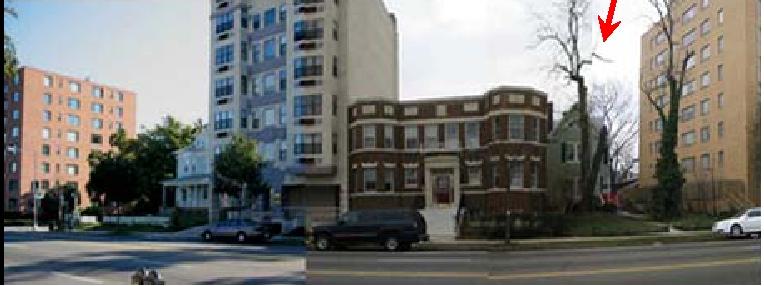
Previous developers at Hastings Development had proposed a wholesale relocation of the house, from its Wisconsin Avenue location in Cleveland Park to a vacant lot at 3118 Quebec Place NW.  A 2008 report from Hastings Development described the sad case of a home that had "lost its setting" and was "pressed between multifamily apartment buildings."  Pictures illustrating this point depicted a forlorn two story house dwarfed on each side by looming monoliths and fronted by a hectic thoroughfare.  Encroachment was gradual; to the south, an eight-story apartment building was constructed in 1958, and to the north, a (unsightly) seven-story building went up in the Eighties.  In contrast, 3211 was a modest, two-story frame house, set back from the street with a small front yard.  


But the HPRB rejected this proposal, later saying that the "new location and context was inappropriate for the building," despite the fact that its initial report found the Quebec Place lot "would provide a more visually compatible context of similarly sized and scaled single family houses."  An HPRB report noted that the house was "deteriorating and vacant" and was "in need of substantial repair" as well as missing the original porches. Additionally, there was speculation that the original builder and architect of record, a Treasury Department bookkeeper named Donald Macleod (he built the house for his sister Euphemia), had simply copied the plans for the house out of a builder's manual or pattern book, theoretically reducing the house's value as a historical artifact.

Following the denial of the relocation request, developers changed gears and planned to raze the house and build a six-story apartment building much like the surrounding ones - that is, until the property changed hands at the last minute.  So what's next for the once-endangered house?

"We have no applications pending [regarding 3211 Wisconsin]," says Callcott.  "We're not exactly sure what's going to happen to it."

Washington D.C. real estate development news

Friday, May 25, 2012

During a concept review hearing yesterday, the Historic Preservation Review Board voted 5 to 2 against granting The Third Church of Christ, Scientist and ICG 16th Street Associates, LLC an exception that would allow them to build a mixed-use church and office building more than 90 feet high at 910 16th Street (between K and I), where the church currently stands. This would have broken a restriction placed on the historic district of 16th street, which leads to the White House and is where The Third Church of Christ now stands.  The review did not include discussion of the highly contested demolition and rebuilding of the church.

Historic Preservation Office staff members David Maloney and Steve Callcott presented a 16-page report urging the Board to deny an exception for a number of reasons, including incompatibility “with the character of the street as a whole” and a fear of creating a precedent of breaking the height rule on 16th Street.

According to the report, "The proposed structure would exceed the 90-foot height limit in several respects. The street facades would extend above the limit to 93.7 feet, calculated from the allowable measuring point on I Street. An extra ninth floor would rise to 107.7 feet, with a 30-foot setback from 16th Street and a 15-foot setback from I Street. The top of the mechanical penthouse would be at 123.7 feet.”

Originally, the project was proposed as an 11-story building with a copper façade. Following comments from the HPO, ICG and architect Robert A.M. Stern Architects partner Graham Wyatt scaled it down to a 9-story building with a stone façade for it to blend better with neighboring buildings.

Since the height restriction has been controversial for years and because this is a historic district, Maloney said it would create a slippery slope with a precedent that other developers could use to break this rule and begin to break down the historic district's uniformity.

“The physical nature of the historical district … is established by the requirement that has been in place since 1894 not to exceed 90 feet,” Maloney said.

ICG principal David Stern, Third Church member Darrow Kirkpatrick and Wyatt represented the project.

Stern said he hoped the project wouldn’t be judged on what might happen, while Kirkpatrick called the report a “substantial burden on our religious beliefs” (though it should be noted the only thing in question was the height of the office building, specifically the addition of a ninth floor, which would not include any part of the church, according to the renderings presented by Wyatt).

The hearing lasted approximately three hours, though it wasn’t until the final twenty minutes that board member Rauzia Ally asked Wyatt what seemed like the most important question: Why does it need a ninth floor?

His answer was that the church is set back into the building and takes up valuable office space, which would be reclaimed by adding a ninth floor. The board was not impressed.

The room filled almost completely for the hearing, and various arguments took place throughout the day including attacks on Wyatt’s architecture, complaints about the lack of religions iconography on the building and arguments about from where in the city can one actually see the extra floor (which is set back 30 feet in the plans).

Several members of the area’s ANC spoke, including 2B chairman Will Stevens, who complained that the staff report never mentions the ANC and said, “Not only will [the ninth floor] not detract, it will add historical flair.”

Former Washington Post columnist and University of Maryland professor emeritus Robert Lewis argued in favor of the extra floor by questioning if it would actually set a precedent.  David Alpert founder of Greater, Greater Washington said, “Historic preservation is … becoming the anti-height movement.”

Gretchen Pfaehler, Nancy Metzger and Robert Sonderman also voted to adopt the staff report’s recommendations.  Pfaehler explained her decision concisely: “That’s the law.”

Washington D.C. real estate development news

Friday, December 31, 2010

Earlier this year Valor Development LLC purchased the former Italian Embassy at 2700 16th St. NW for $7.5 million in what will be a second attempt at condo development on the site. Partnering with Potomac Construction Group, Valor intends to renovate the embassy into condominiums, add a three-story wing on the north side of the building (also to house condo units), and construct a nine-story apartment building at the rear of the site. Earlier this month developers' plans and the architectural diagrams provided by Trout Design Studio went before the Historic Preservation Review Board (HPRB). While the HPRB found the conceptual site plan and rehabilitation of the landmark satisfactory, members of the Board directed the applicants to "restudy the architectural treatment of the north wing, and restudy the height, massing and architectural treatment of the new apartment tower, and return for further review when appropriate."

The first phase of the "Flats at IL Palazzo" will be the restoration of the landmark's facade and the conversion of the interior into condominium units "blending the character and charm of the historic building with the sophistication, class, and modern finishes that one expects in this premium location," according Valor's online description. The interior restructuring and transformation will preclude several significant interior spaces: the ballroom, library, dining room, and other smaller spaces will be preserved with some opportunity for public use and visitation. The second phase will include the north wing addition and the construction of the apartment tower, but those elements remain unapproved by HPRB.

Plan rejected in 2006.
Another development team in 2006 was close to moving forward with similar development plans for the ex-embassy, when HPRB designated the property an historic landmark just before construction was to begin, in part because the new tower would have eaten into part of the historic structure. HPRB asked the city to revoke the building permits for the 79-unit Il Palazzo condominium, a decision the developer litigated and lost. This go-round developers have moved the proposed apartment tower from near the front to the northwest corner of the site, far-removed from the 16th Street frontage and centered around a second courtyard. While the overall efforts seem to respect the historic nature of the property, and rearrange the site plan in accordance with HPRB's public wishes, the Board still found the three-story addition "capricious and discordant with the rest of the proposal" and the apartment tower's design to be "busy and composed of too many elements." Developers and designers have been advised to rethink their designs and try again soon. Although this is sure to delay Phase II, developers are still planning to deliver Phase I to the marketplace in summer of 2011.

The last project was spun by Spaulding & Slye, Colliers & Castleton Holdings, lender O’Connor North American Property Partners LP was forced to foreclose on the property, and enabling Valor to swoop in and purchase the site.

Washington DC real estate development news

Monday, November 8, 2010

Call it delicious irony. The U.S. Secret Service, the organization that has seemingly unchallengeable power to take over sites - land, buildings, streets - that it feels it needs to protect the POTUS, are finding it difficult to take over a single building for office space in downtown Washington DC. The building - the historic Webster School - has remained empty for a decade while the agency has been unable to afford renovation, despite its enormous budget and long term lease of the property.

DC residents boxed out of the botched 2009 presidential inauguration and suffering from an ever widening security perimeter around the President may be forgiven a bit of spite toward the enigmatic agency (not that we aren't happy idling in our car for 30 minutes in advance of a Vice Presidential motorcade, and don't even get us started on the Salahi debacle). But the Service says "financial constraints" prevent it from renovating the skeletal eyesore located across the street from the Old Convention Center site and has no plans in the works for the darkened building.

The school, built in 1882, was used to educate naturalized citizens and by DCPS for many years, but saw its last use in the '90s. The National Treasury Employees Union bought the building for $2m and sought to demolish it (claiming special merit for its needs) to make way for a new headquarters, a move thankfully checked by the Historic Preservation Review Board, which then landmarked the building. GSA subsequently exercised eminent domain on behalf of the Secret Service, which hoped to renovate the school as an adjunct facility to its headquarters next door amid rumors of a pending museum for the site. The Service, with an annual budget this year of $1,500,000,000, says it lacks appropriate funding but needs the space for its 7,000 worldwide employees (it won't give the number of employees in DC). "We have plans to make it usable space for Secret Service employees" says Robert Novy, a spokesperson for the Service, dismissing museum theories.

Legally protected from demolition, the building is also being protected from death by natural causes with a minor structural renovation. But with the hole-plugging came exterior scaffolding and plywood sidewalk canopy that has lasted for several years, annoying neighbors, and the Service says it has no immediate intentions, or even designs, to change that until it receives dedicated construction funds. In the interim, the building has been vacant since the Clinton years, a fact that may be noted by an administration that hopes to stanch charges of fiscal profligacy by cutting its inventory of vacant office space, not to mention ax-wielding Republicans that will begin arriving in town over the coming weeks.

So for the time being the corner of 10th and H will remain dark and fenced off, a less-than-inviting streetscape at night, unless the Secret Service can find a way to make money out of a public nuisance. Perhaps they should ask the Salahis.

Washington DC real estate development news

Saturday, November 6, 2010

After receiving support from ANC 1B, Douglas Jemal and his team at Douglas Development hope that the Historic Preservation Review Board (HPRB) are equally kind to their concepts to demolish a forlorn auto shop and build a six-story, 30-unit "apartment house" at 2221 14th Street, NW (see map, left). The development will feature ground floor retail and one level of below grade parking, with spaces for only ten cars and several bicycles.

Courtesy of architects at the relatively new DC firm R2L, the bright and busy concept design draws from a contemporary assortment of glass, metal, brick and terra cotta panels. Sharply angled bay windows protrude from the facade offering apartment dwellers views down both the historic 14th Street and Florida Avenue corridors. Long glass shop windows front the ground floor facade, which will eventually house retail. The environmentally friendly rooftop will feature green landscaping, a lounge deck, and possibly decent views. Architect Sacha Rosen, a principal with R2L, explained that "the massing, form, and rhythm are in the Washington historic tradition, but the details are contemporary." Being located within the Greater U Street Historic District, HPRB will offer feedback shortly, as the project is likely to be included on the Board's next meeting agenda for the 18th of this month.

In early 2009, Jemal, under the guise of "Jemal's Hookers, LLC," was in the process of acquiring raze permits for the vacant auto lot to make room for a new 10,000 s.f. retail development designed by George Myers of GTM Architects. Clearly those plans were scrapped, and this time the metrics are grander. Rosen described the project site as "wonderfully prominent...as one of the historic entrances to the District's core." But given the site's small and irregular shape,
Rosen said his team was presented with the difficult task of designing "a very efficient building that can support an exterior that will do justice to the community's expectations."

Interestingly, a large mural has been proposed for the back wall of the building, facing southwest. The development team has been in contact with G. Byron Peck, a locally based and nationally respected muralist about commissioning the mural's creation and installation. Peck is responsible for the "Black Family Reunion" mural which has been on the wall
of the adjoining property for many years. He also painted the portrait of Duke Ellington located on the wall of Mood Indigo at the corner of 13th and U Streets NW since 1997.

The often painstaking approval process should be finished by February 2011, with design documents complete in late Spring 2011, and developers are optimistically planning for a Summer 2011 groundbreaking.

Washington D.C. Real Estate Development News

Friday, November 5, 2010

The historic Corcoran Gallery of Art is set for a significant addition in the near future, as Carr Properties and architects at SmithGroup have submitted a design concept to the Historic Preservation Review Board (HPRB) for feedback. A recommendation will be returned by the HPRB at its next meeting on November 18th. Their recently submitted application reveals that developers are attempting to move forward with a nine-story office addition to the previously expanded northwest corner of the art gallery that was originally designed by Charles Adams Platt in the 1920s.

Although some Corcoran staff may occupy offices in the new building, it will act and operate separately, generating lease revenues that will assist the Gallery in its effort to grow the collection and the College of Art's endowment. While operating separately, the structure is technically intended to be an addition, as original plans have always called for an expansion of the Gallery in this direction; the addition will be connected to the original 1890s building through a stairwell and partly cantilevered over the Clark Wing.

In August, the Corcoran Gallery granted Carr Properties a long term ground lease of the site on which developers will apparently build, own, and operate the new offices. Unless an extension is requested by Carr, if all the required public approvals are not secured prior to December 15th of next year, the lease will automatically terminate. The property's street address is 1700 New York Avenue, NW, fronting New York Avenue to the south and E Street to the north. Rising several stories above the Corcoran Gallery of Art, the top floors of the addition will offer panoramic views of the White House, the National Mall, the Capitol, and the various surrounding monuments. In addition to office space and a basement for storage, the expansion will also increase parking availability at the gallery, with three levels of garage set to sit below the new building.

The recently submitted designs by SmithGroup go in a much different direction from previously submitted plans. Hartman-Cox had received approval from the Board of Zoning Adjustment (BZA) and the Historic Preservation Review Board as far back as 1988, but never followed through on their plans for a 120,000 s.f. addition. Again in 2008, Hartman-Cox resubmitted similar renderings on behalf of the Corcoran Gallery, but HPRB called the firm's aesthetic of choice "clearly historicist, [and] perhaps more in vogue in the 1980s than at present," advising the architects to reconfigure the building's design so to more "clearly reflect its own identity and purpose." Smith heeded this advice with hopes that their starkly modern and minimalist stylistics will be better received by HPRB; but developers know that regardless of the outcome, a long road of applications and meetings and approval decisions lies ahead.

Washington D.C. Real Estate Development News

Tuesday, November 2, 2010

Tally another mixed-use development for the Almighty, as religious groups around the District seem to have a leg up in building these days (Bethesda church, Clarendon church). Following a long and contentious Zoning review process, and following several trying meetings with the Historic Preservation Review Board (HPRB) and the National Park Service (NPS) concerning the project's potential effects upon the neighboring Fort Stevens, the Emory United Methodist Church Beacon of Light in Brightwood received Board approval in the early Spring, and are finally ready to move forward with their Beacon Center project.

Granted a raze permit for 6120 Georgia Ave, NW late last week, neighbors can expect demolition and construction to begin shortly.
The $30 million development, designed by PGN Architects, will offer 180,000 s.f. of multipurpose housing and various congregational and community facilities. The Beacon Center will supply transitional spaces (24 units) in an effort to aid the homeless work toward permanent residency. Also in the works are 34 units for seniors citizens, 17 units reserved for veterans, and 16 affordable rentals. A college-sized indoor multi-sport gymnasium (basketball and soccer) and rec center will be available to the surrounding community. The aggressive expansion will also feature a full service banquet facility, office space for the church and for lease, senior citizens services (such as optometrist, podiatrist, etc.) and ground-floor retail. Additionally the current sanctuary (doubling as a community theater) will be renovated and expanded to 500 seats. Patrons will have access to roughly 100 underground parking spaces and several rows of bike spaces.

Sean Pichon,
a Partner at PGN Architects, said his firm has been especially challenged by the need to adjust their designs to the steep grade of the property. Other difficulties included maintaining the "view corridors" and balancing the affordability of the project with the goal of an attractive and congruous facade. Working hard to best the obstacles, designers created features like "curved green roofs" over the retail space to create and "continue the imagery of the hillside." To allow for views from Georgia Avenue his team situated the main entrance on the side road, Quackenbos; this maneuver also enabled multiple access points and preserved the historic stairs leading up to the old church.
Not all were satisfied, however, as the NPS and Civil War Preservation Trust wrote strong letters of opposition, contending that "the proposed five-story wall along Old Piney Branch Road would create a significant visual intrusion on the fort." Opponents also voiced concern that "the Beacon Center’s overall size and floor plan [read too big]...would have an adverse impact on Fort Stevens and subsequently the other remaining Circle Forts." But the representatives of the Church, including the Pastor, convinced Zoning Board members that they had made significant and genuine efforts at compromise, with the Board ultimately deciding that the overall positives of the project outweighed what little impact the building might have on its neighbors. Instead of a reduction in height and massing, NPS will have to settle for 359 square feet in the new building, reserved for their use as a welcome center/gift shop to "educate and promote the history of Fort Stevens." Reenactors and Fort Stevens staff can imagine the impending sounds of the Bozzuto-lead demolition and construction as the distant rumblings of the long ago battles.

Washington D.C. Real Estate Development News

Friday, October 29, 2010

Yesterday, the Historic Preservation Review Board (HPRB) recommended approval of a six-floor office space development at 1525 14th Street, NW in the 14th Street Historic District. Originally approved in 2004 as a seven-floor residential project, developer Giorgio Furioso of Furioso Development decided to switch gears given the difficulty of financing and unloading a small-scale condo operation under current conditions. With the change from residential to non-residential, Furioso also ditched original architect Sorg for updated concept designs from Eric Colbert & Associates.

The development will be sandwiched by two eateries, as it is set to occupy the empty space (currently a parking lot) between the beloved Great Wall Szechuan House and the highly reviewed Posto. The project calls for an additional three stories to be affixed atop the historic and stylish facade of 1515 14th, "a classically-styled automobile showroom constructed in 1928 for a Hudson dealership" that now houses Posto on the ground-floor, and an art gallery on the top level (both entities will remain). The addition to 1515 will be set back roughly 20 ft. from the front façade, so as not to compromise the architectural integrity of the building. Furioso is proposing that the first two floors of the total 55,000 s.f. house retail tenants, while the remaining four levels will be reserved as office space. The building will rest atop three below-grade levels, the first for storage, and the bottom two accessed by a car elevator for parking.

The originally proposed residential project offered a much different aesthetic, as architects at Sorg had initially designed a Cubism-inspired building reminiscent of the work of Frank Gehry. And while the density and massing of the new proposal remain the same, the design is entirely reworked. Although not boring, the new design is certainly less adventurous than the previous. And while the design and materials remain of a modern flavor, the prevailing stone curtain system, and the arrangement of the columns, help better reflect and mesh with the proportions and the large showroom windows of the historic building next door.

HPRB Staff Reviewer Steve Callcott had previously expressed concerns about fluorescent fixtures from the offices becoming an unattractive anomaly on the historic nighttime streetscape. Due to these concerns one of the earlier drafts, a design employing a more generous use of unobstructed glass, was scrapped for the presently submitted rendering (pictured at the top). Architect Eric Colbert explained that increased architectural complexity on the facade as well as added louvers had diminished views into the office levels and alleviated Callcott's concerns. With Callcott and the Board's approval, the development team will now submit their proposal to the BZA, with a groundbreaking still some time off.

Washington D.C. Real Estate Development News

Friday, September 10, 2010

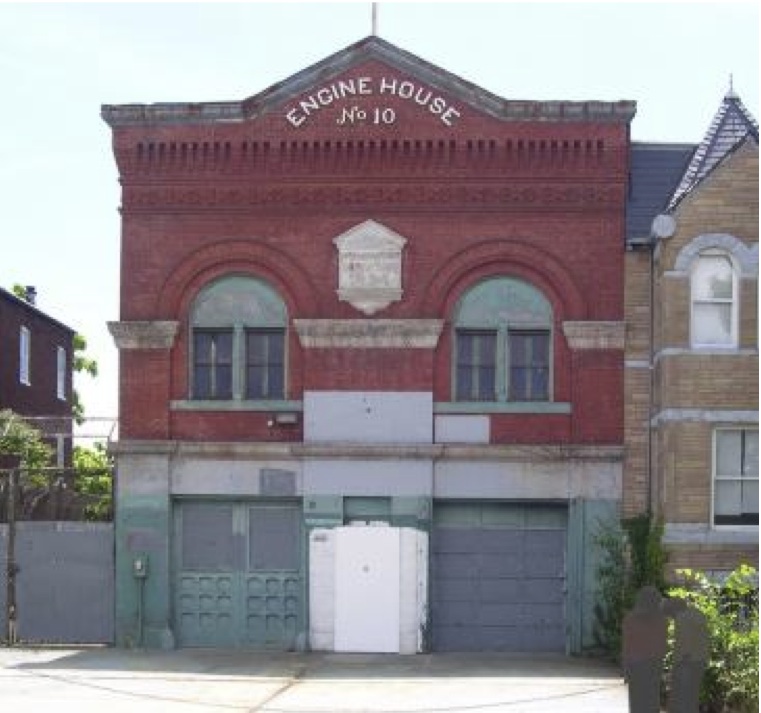
Roughly two months ago, the DC City Council voted to release several District properties for redevelopment, but the most noticeable deal in the large release is the transaction that enables Argos Group, in partnership with Potomac Investment Properties Inc., to scoop up the historic Hurt Home mansion at 3050 R St. NW, a "contributing" building in the Georgetown Historic District, for $450,000. The deal is pending, and Jose Sousa of DMPED cautions that "[t]hese numbers are not yet final." But Sousa and Argos Principal Gilberto Cárdenas estimate that all the minor details will be chiseled out in the next couple weeks. Cárdenas has plans to redevelop the former assisted living facility for the blind, and more recently the Devereux Children’s Center for foster children, into a 15-unit luxury condominium. This isn't Argos's first effort at acquiring and transforming a vacant, District-owned, historic property into high-end condos: the development group broke ground on the renovation of the Northeast's historic Firehouse No. 10 and Police Station No. 9 earlier this summer.

Argos has again contracted familiar partners Sorg Architects for the design work, and developers are leaning towards bringing in another interior design specialist to assist with some of the remodeling work. Three poorly executed wood additions will be stripped from the back of the original brick exterior, while the interior will be almost entirely gutted and rebuilt, walls, stairs, mechanicals, and all. The facade of the building will be improved and restored to its original historic charm, accented by giant two story front windows and an entrance stoop railed with hefty white columns. When finished the condos will be a spacious 1200-1700 s.f., each with two to three bedrooms and loft space. Given that the property was put mostly to philanthropic uses over the course of its long history, developers have agreed to offer three of the units at affordable rates and reserve them for blind citizens. Designers plan to link up with the American Council for the Blind to methodically outfit the units to meet the domestic daily needs of those living without sight. The back lot will be extensively landscaped, and a 30 car parking lot will be installed. Developers say there is a strong chance several Zip Car spaces will be included.

Sorg already oversaw the G-town Post Office Renovation
After the City Council meeting in July, Councilman David Catania seemed unsure of the decision: WBJ quoted Catania wondering why they'd "sell a property for $450,000 that’s worth $6.1 million," and asking, "Why not bid that out just to make sure we have the best reimbursement for the taxpayers?” But although at least five or six developers toured the property following the District's Request for Expressions of Interest (RFEI) last summer, Mr. Cárdenas and his partners were the only ones to go forward with an offer, and negotiations went from there. Initial plans called for an addition to the building and as many as 41 units, with the building being offered for more than $1.5 million. But it quickly became clear that community organizations, Zoning Commission, and the Historic Preservation Review Board would combine forces to put a quick stop to a proposal of such proportions, and so the number of units, with some back and forth community dialogue, was slowly reduced to 15.

Cárdenas reckons that other developers were reticent to get involved with the sometimes stubborn and often vocal Georgetown community. "They're a community that knows what they want, are well organized, and have the resources to force compromise," says Cárdenas, "but we came into this project with nothing but a positive attitude, good intentions, and willingness to compromise." Jose Sousa confirmed this, saying: "The development team worked in concert with the surrounding neighbors to address many of the concerns raised regarding parking and unit counts." Although the vetting process has already started, developers don't expect the receive final Zoning and HPRB approval for approximately a year. If all goes smoothly, construction will begin shortly thereafter.

Washington D.C. Real Estate Development News

Thursday, August 26, 2010

The D.C. Preservation League, which annually issues a list of the District's most endangered properties in hopes of scaring developers into action, and preservationists into sign-painting and check-writing, has recently issued its new list for the year. This year the Preservation Leauge has focused it's 2010-attention on the preservation and renovation of the District's neglected firehouses. A special emphasis was placed on pre-WWII firehouses and police stations. Thankfully, two years ago Argos hammered out a deal with the District to redevelop two foresaken buildings: Firehouse No. 10 at 1341 Maryland Avenue, NE and Police Precinct No. 9 Station at 525 9th Street, NE. Developers refer to the two renovations as the Capitol Hill Condominiums, "The Station" and "The Engine House" respectively. In 2008 the Historic Preservation Review Board designate Engine House No. 10 as a Historic Landmark. While the 115-year history of public use of the firehouse will be sacrificed for the purpose of private residences, the character of both buildings, and their attractive, storied facades will be maintained for the enjoyment of passers by and history-lovers alike.

Designed by architect and firehouse specialist Leon Emile Dessez (1858-1919), erected in 1894, and completed in 1895, HPRB claimed in 2008 that the structure "is probably the best and most characteristic example of a Victorian-era firehouse still owned by the District." Sorg Architects has tackled the challenge of retrofitting the building with two market rate condos and two smaller affordable units. The former police station on 9th Street will be an almost identical project, with just enough room for an additional condo. The footprint of both the Engine House and the Station will be strictly maintained, with both facades to be restored with masonry refurbishment, various touch-ups, and only the slightest of noticeable augmentations. Windows and doors will be replaced, fading paint of old will be stripped away, and the addition of a few small second floor awnings will ready the building for residents. The interiors on the other hand will be completely gutted and overhauled - the roof, walls, flooring, HVAC, plumbing, electricity, and the works will all be replaced.

An unusual occurrence in the development world, construction on both projects began exactly on time, breaking ground two months ago as originally promised. Work is now chugging along with completion of each building expected in April of next year.

Washington D.C. Real Estate Development News

Tuesday, July 27, 2010

Formerly home to the Southwest Community House Organization (SWCH), a now defunct non-profit social organization that had served the encompassing low-income neighborhoods of southwest D.C., a historic black and white, detached brick house at 156 Q Street, SW is once again the James C. Dent House. Last week the Historical Preservation Review Board gave its blessing of historical protection to the property and recommended to the National Park Service that the home be listed in the National Register of Historic Places. The home is located on Buzzard Point, the urbanized sector of the peninsula formed by the confluence of the Anacostia and Potomac Rivers.

The southwest quadrant of the original city of Washington has a long and storied past, and is home to some of the oldest buildings in L'Efant's originally planned cityscape. Often forgotten as an original site for the many large, gracious river front mansions that housed much of the political elite, the area is most frequently chronicled for its reputation as a shabby neighborhood of awkward racial diversity. In 1920, Washington Star journalist John Harry Shannon (aka "The Rambler") wrote of the areas frequently overlooked but nonetheless pedigreed heritage:


"It is not easy to name a member of an old South Washington family whose grandfather or grandmother did not live between the Arsenal and the two rivers. Thousands of men and women now living in the 'parks: 'heights' and 'terraces' will cast their thoughts back to the old family home on the Navy Yard or the Island. It was not many years ago that Northwest Washington was commons, pastures, bog, forest, rugged hill and steep ravine. What is now South Washington was then all Washington, with the exception of a narrow fringe of settlement north of the Avenue."
Early nineteenth century plans for the construction of stately homes and a bustling commercial district never quite fully materialized, and for over a century the southwest, consisting mostly of what is known as "the Island," remained a modest residential host to the rowhouses, tenements, shacks, and even the odd tent of blue-collar workers, the majority of them African Americans with a small portion being working-class whites (predominantly Jewish). Although the increasingly putrid James Creek turned Washington City Canal and a series of explosions at the Washington Arsenal cemented the area as one of the less desirable parts of the city, the neighborhoods were symbolic of the ever fleeting American dream for the newly emancipated, as many freed African Americans had looked to build new lives and legacies on these lands since the days immediately following the Civil War.

Perhaps no Southwest resident is more emblematic of this dream of social and economic ascension than James C. Dent. Born into slavery in 1855, Dent grew up a farm laborer in the tobacco country of southern Maryland. Dent eventually made his way to southwest D.C. as a laborer, mostly employed in a lime kiln, and married a Virginia seamstress. In 1885, his wife Mary and several parishioners founded the Mount Moriah Baptists Church. Several months after it opened the first pastor stepped down, and in May of 1886 Dent took his place and proceeded to take the church to prominence within Washington's black religious community - overseeing it's transition into several newer and nicer buildings (it is now located on East Capital Street, NE), and serving as pastor for over 22 years.

In 1906, in an unusual move indicative of the racial and economic disparity of the area, Dent hired a white architect to build a house to replace the modest, timber-framed dwelling he had lived in with his wife for many years. William James Palmer, a prominent rowhouse architect, was commissioned for the design. During the year of construction, Palmer, whose body of work was largely concentrated in Dupont Circle and Columbia Heights, was praised in the Washington Post for designing a row of houses in Mt. Pleasant that exhibited "architectural beauty, stability, and refinement of taste." A couple non-residential, Palmer-designed properties of note include Union Methodist Episcopal Church, as well as the Navel Lodge and AME Church on Capitol Hill. While Dent's home may seem rather average in appearance compared to the contemporaneous homes of the designated historic districts to the north and northwest, the detached brick edifice was no doubt a remarkable anomaly among the many surrounding shacks on Buzzard Point, and even more exceptional for having endured the "urban renewal" of the 1950's that saw many of the areas homes and churches razed.

As the setting of a unique American story, in which an African American man made the transition from slave to property owner to middle class professional within a single generation, the HPRB has designated the James C. Dent House a D.C. Landmark. In doing so, a small but unique part of the narrative of racial progress within the nation's capitol will be forever preserved. The building is now owned by PEPCO, and has stood vacant since SWCH left in 2004.

Washington D.C. Real Estate Development News

Tuesday, July 6, 2010

Unifying the neighborhood is the task at hand for JBG Companies and west coast-based architecture firm Miller Hull Partnership LLC as they continue planning a mixed-use retail and residential development in Shaw on Florida Avenue and 8th Street NW near the U Street Corridor.

The companies presented preliminary plans to the Historic Preservation Review Board Thursday for input on the overall concept and support for moving a historic building and an alley way on the site to make way for two new buildings on the mostly empty lots.

While the board was mostly receptive to the idea for development including moving a historic building, members encouraged developers to make the building relate to the neighborhood. The property falls into the Uptown Destination District Plan, dubbed "DUKE," aimed at creating an arts and entertainment hub in the area of U and 7th streets. The plan identifies the vacant lots as a "gap" in the neighborhood.

“You, the architect and developer, have a responsibility to knit this neighborhood back together,” said board member Graham Davidson who expressed his interest in the project while reminding the developers of the expectation to create more than an iconic building. “There's a big hole in the neighborhood here."

Below: Brian Court of Miller Hull Partnership LLC presents plans for development at Florida Ave. and 8th St.
The proposed concept places two 6-story buildings on Florida Avenue with retail on the ground level and five floors of residential units above. The building facades could be made of concrete, full-height windows and metal panels. Final decisions on building materials have not yet been made, though individuals present at the meeting said JBG proposed a wood-framed building.

In an effort to both increase density and blend with the neighborhood, Brian Court, an associate with Miller Hull, explained that the buildings would decrease in height along 8th Street to transition into the mostly residential part of the neighborhood. The building is intended to have a modern feel while reflecting the overlaying arts district and the established urban community.

The HPRB wasn’t entirely convinced. Board members agreed that the project needed more consideration. Concerns included using building materials that fit well with surrounding buildings, reducing the size of the building as it approaches the smaller residential structures on adjacent properties, and generally making the project fit the community.

Steve Callcott, deputy preservation officer for the Historic Preservation Office who has been working with JBG on the project, said he wasn’t surprised by the board’s reactions to the proposal. Board reviews of projects like this one, he said, open the door for "back-and-forth" discussion and offers a developer some "general guidance and direction."

This development is not the first planned for the lots at Florida Avenue and 8th Street. Banneker Ventures previously planned to develop the site, but controversy surrounding the company's selection for several DC projects ultimately derailed those plans.

Washington D.C. real estate development news

Monday, July 5, 2010

For some residents of Hill "proper," Hill East is the ugly duckling of Capitol Hill. Its numbered streets have double-digits, its architecture is eclectic. And isn't it near...the river? While many Hill East residents are eager to prove the neighborhood has charm and historic character, others, including long-time residents, are happy to keep the long arm of the preservationists away. Last week, the Historic Preservation Review Board decided to wait a little longer before officially creating the Barney Circle Historic District that would bring the same level of historic protection that Capitol Hill now enjoys.

The Capitol Hill Historic District's eastern boundary is 13th Street SE, with parts of 14th Street included. As you venture beyond the confines of the historic area, the boundaries do much to explain the odd mix of new 4-story condos next to the townhouses. The Barney Circle area is bounded by "the houses fronting on Barney Circle on the south, by those on the north side of Potomac Avenue on the north, by those on the west side of Kentucky Avenue on the west and by the Congressional cemetery on the east," according to the HPRB.

Once the terminus of the Pennsylvania Avenue Streetcar, the neighborhood was built largely between 1905 and 1929, inhabited mostly by employees at the nearby Navy Yard. The homes were contrived from Henry Wardman's "daylighter" model, which offered a suburban feel with a front yard, front porch and copious daylight inside. The HPRB staff report recommended an approval, noting the neighborhood as a "prime example of an extremely cohesive and intact early twentieth century, working-class, rowhouse neighborhood." The "period of significance" for the ares was determined to be between 1905 and 1941; of the 192 homes in the new district, all but 3 will come under the auspices of the HPRB.

The Historic recognition would mean more headaches for the owners of the 189 homes. The Capitol Hill Restoration Society (CHRS) quickly points out on its website that being in an historic district means that "if you want to install a fence, make any changes to the porch, garage, or exterior of your building, or even install sculpture in your front yard, you must get a building permit." Though the ANC voted unanimously to approve the nomination, neighbors will take their time to debate the merits of the recognition; HPRB was prepared to approve it last week but has left the door open for a larger area to be included, should the community request it.

Washington, DC real estate development news