Formerly home to the
Southwest Community House Organization (SWCH), a now defunct non-profit social organization that had served the encompassing low-income neighborhoods of southwest D.C., a historic black and white, detached brick house at
156 Q Street, SW is once again the
James C. Dent House. Last week the
Historical Preservation Review Board gave its blessing of historical protection to the property and recommended to the
National Park Service that the home be listed in the
National Register of Historic Places. The home is located on
Buzzard Point, the urbanized sector of the peninsula formed by the confluence of the Anacostia and Potomac Rivers.
The southwest quadrant of the original city of Washington has a long and storied past, and is home to some of the oldest buildings in
L'Efant's originally planned cityscape. Often forgotten as an original site for the many large, gracious river front mansions that housed much of the political elite, the area is most frequently chronicled for its reputation as a shabby neighborhood of awkward racial diversity. In 1920,
Washington Star journalist
John Harry Shannon (aka "The Rambler") wrote of the areas frequently overlooked but nonetheless pedigreed heritage:
"It is not easy to name a member of an old South Washington family whose grandfather or grandmother did not live between the Arsenal and the two rivers. Thousands of men and women now living in the 'parks: 'heights' and 'terraces' will cast their thoughts back to the old family home on the Navy Yard or the Island. It was not many years ago that Northwest Washington was commons, pastures, bog, forest, rugged hill and steep ravine. What is now South Washington was then all Washington, with the exception of a narrow fringe of settlement north of the Avenue."

Early nineteenth century plans for the construction of stately homes and a bustling commercial district never quite fully materialized, and for over a century the southwest, consisting mostly of what is known as "
the Island," remained a modest residential host to the rowhouses, tenements, shacks, and even the odd tent of blue-collar workers, the majority of them African Americans with a small portion being working-class whites (predominantly Jewish). Although the increasingly putrid
James Creek turned
Washington City Canal and a series of explosions at the
Washington Arsenal cemented the area as one of the less desirable parts of the city, the neighborhoods were symbolic of the ever fleeting American dream for the newly emancipated, as many freed African Americans had looked to build new lives and legacies on these lands since the days immediately following the Civil War.
Perhaps no Southwest resident is more emblematic of this dream of social and economic ascension than James C. Dent. Born into slavery in 1855, Dent grew up a farm laborer in the tobacco country of southern Maryland. Dent eventually made his way to southwest D.C. as a laborer, mostly employed in a lime kiln, and married a Virginia seamstress. In 1885, his wife Mary and several parishioners founded the
Mount Moriah Baptists Church. Several months after it opened the first pastor stepped down, and in May of 1886 Dent took his place and proceeded to take the church to prominence within Washington's black religious community - overseeing it's transition into several newer and nicer buildings (it is now located on
East Capital Street, NE), and serving as pastor for over 22 years.
In 1906, in an unusual move indicative of the racial and economic disparity of the area, Dent hired a white architect to build a house to replace the modest, timber-framed dwelling he had lived in with his wife for many years.
William James Palmer, a prominent rowhouse architect, was commissioned for the design. During the year of construction, Palmer, whose body of work was largely concentrated in Dupont Circle and Columbia Heights, was praised in the
Washington Post for designing a row of houses in Mt. Pleasant that exhibited "architectural beauty, stability, and refinement of taste." A couple non-residential, Palmer-designed properties of note include
Union Methodist Episcopal Church, as well as the
Navel Lodge and AME Church on Capitol Hill. While Dent's home may seem rather average in appearance compared to the contemporaneous homes of the designated historic districts to the north and northwest, the detached brick edifice was no doubt a remarkable anomaly among the many surrounding shacks on Buzzard Point, and even more exceptional for having endured the "urban renewal" of the 1950's that saw many of the areas homes and churches razed.
As the setting of a unique American story, in which an African American man made the transition from slave to property owner to middle class professional within a single generation, the HPRB has designated the James C. Dent House a
D.C. Landmark. In doing so, a small but unique part of the narrative of racial progress within the nation's capitol will be forever preserved. The building is now owned by
PEPCO, and has stood vacant since SWCH left in 2004.
Washington D.C. Real Estate Development News RSS Feed
 Twitter
 6:54 PM
 Unknown
 The DC government today issued a request for proposals for up to 300,000 s.f. of development rights near the ballpark and Buzzard Point, inviting developers to bid on land within the "Capitol Gateway" overlay areas of southwest and southeast DC.
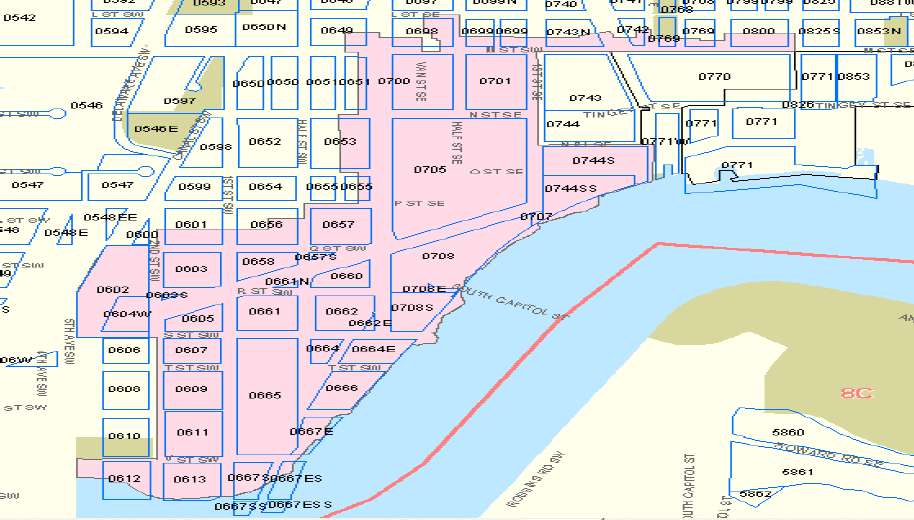 The District of Columbia, through the Office of the Deputy Mayor for Planning and Economic Development (DMPED), is putting development rights up for bid in the form of Combined Lot Development rights - additional square footage for landholders within the overlay. The areas are designated for mixed use development, under the current regime developers are able to combine two lots and transfer density between them. The initiative unveiled today adds an additional 300,000 s.f. of development rights within the zone, increasing the density within the high-growth corridor that lines the Anacostia waterfront.
 The Request for Expressions of Interest was issued in an 8-page publication - a more streamlined version than past requests, reducing the technical compliance burden on developers. Responses to the request are due August 31st.


